The Eight Manifestations of Guru Rinpoche: A Guide to Padmasambhava’s Power and Symbolism
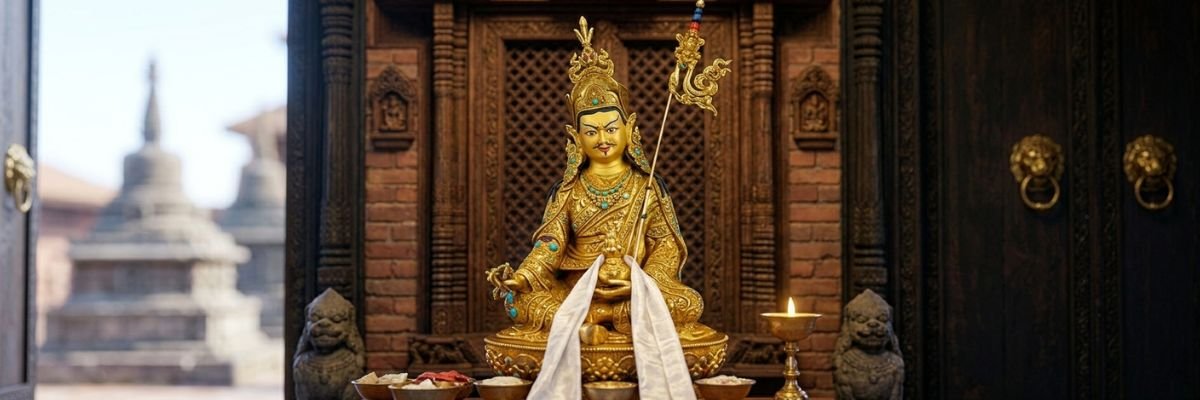
Padmasambhava, reverently known as Guru Rinpoche (Precious Master), is the "Second Buddha" in the Nyingma tradition of Vajrayana Buddhism. He is a primary force behind the establishment of Buddhism in Tibet, a master of skillful means who could transform any environment into a mandala of wisdom.
A core teaching within this lineage is the principle of the "Eight Manifestations of Guru Rinpoche" (Guru Tshengye). These are not separate beings but distinct aspects of his enlightened activity, which he displayed to meet the specific needs of different places and practitioners. This teaching reminds us that wisdom can appear in many forms—peaceful, wrathful, or miraculous. In this article, we will focus on three key manifestations and explore the profound symbolism of the tools he carries.
I. The Key Manifestations
While all eight manifestations are vital, three stand out as particularly significant entry points into his wisdom.
1. Guru Pema Jungne (The Lotus-Born One)
This is Guru Rinpoche's primary and most common form. It depicts him not as a physical child but as an enlightened master who appeared fully formed on a giant lotus in Lake Dhanakosha. This birth itself is a miracle, signifying that his essence is non-dual, immaculate, and beyond the reach of samsaric birth and death. As Pema Jungne, he represents the quintessential Guru—wise, compassionate, and perfectly realized. He is often seen seated on a lotus throne, symbolizing that his wisdom arose directly from pure, untainted space.
2. Guru Dorje Drolo (The Vajra-Wrathful)
This manifestation represents the intense, blazing energy required to subdue particularly stubborn obstacles and negative forces. Dorje Drolo is a profoundly wrathful figure, depicted with a fearsome expression, standing on a female tigress, and surrounded by a blaze of wisdom fire. He manifested in thirteen secret caves in Bhutan and Tibet, transforming demonic forces that were hostile to the Dharma into protectors. Pema Jungne is the wisdom that cuts the illusion, and Dorje Drolo is the dynamic, protective energy that ensures wisdom prevails. His image is a reminder that compassion is not weakness, but a powerful force that can be employed fiercely to destroy suffering.
3. Guru Nyima Ozer (Rays of the Sun)
This manifestation highlights the all-pervasive, illuminating power of his wisdom. While as Dorje Drolo he was fierce, in this form he appears as a yogi, radiating intense light and heat. Legends describe how he could focus the sun’s rays, turning entire mountains into precious stones or subduing hostile dakinis. As Nyima Ozer, he is the light of clear realization that dispels the darkness of ignorance. His form is vibrant and radiant, symbolizing the inherent, unstained brilliance of the nature of mind.
II. Decoding the Divine Instruments: The Three Main Hand Attributes
When you see a statue of Guru Rinpoche, his posture and the objects he holds are never random; each is a map of a spiritual realization. Here are the three main attributes you will almost always find:
1. The Vajra (Dorje)
Held in his right hand, the vajra (Sanskrit for "diamond" or "thunderbolt") is the defining symbol of Vajrayana itself. It is the scepter of immutable reality. Just as a diamond can cut anything but cannot be cut, and a thunderbolt is an irresistible force, the vajra symbolizes the indestructible and unchanging nature of pure awareness. It represents skillful means and compassionate action. It is also a tool of transformation—a scepter that converts negative energies into the five aspects of pristine wisdom.
2. The Kapala (Skull Cup)
In his left hand, usually resting in his lap, Guru Rinpoche holds a kapala, a cup made from the top of a human skull. To the uninitiated, this might appear macabre, but in Vajrayana, it is a symbol of bodhicitta (the mind of awakening) and the realization of emptiness. It signifies that the dualistic, conceptual mind (symbolized by the physical skull) has been transformed into a vessel for wisdom and bliss. Within the cup is often depicted the "nectar of immortality," signifying the realization that once death is understood as part of reality, one is liberated from its fear.
3. The Khatvanga (Tantric Staff)
The khatvanga, supported by his left arm, is a complex, richly symbolic staff. It represents the non-dual union of all contradictory forces: masculinity and femininity, skillful means and wisdom, nirvana and samsara. The staff itself is segmented: the base is a half-vajra, and the shaft is tipped with three skulls and a trident. These represent the triple gem (Buddha, Dharma, Sangha) and the victory over the three poisons (ignorance, attachment, and aversion). Most importantly, the khatvanga is considered a secret depiction of his consort, Mandarava, which signifies the inseparable unity of bliss and emptiness.
III. The Divine Placement: Why His Statues Face the Entrance
You may notice in many Nyingma monasteries, or in traditional homes, a statue of Guru Rinpoche is placed directly facing the main entrance or doorway. This isn't just an artistic convention; it is a direct application of his protective function.
The space of a mandala, or any sacred space, must be secured. Guru Rinpoche, as the king of protectors, is placed here as a symbolic gatekeeper. His presence at the entrance serves to:
Repel Obstacles: He stands as a barrier against outer negative forces, ensuring that only positive, purifying energy enters the space. This is a practical application of his Dorje Drolo aspect.
Ensure Safe Passage: For those entering, he is the compassionate guide, ensuring their intentions are transformed as they cross the threshold.
Remind Us of the Threshold of Awakening: Every doorway represents a potential transformation. Seeing his face as we enter a sacred space reminds us that we are leaving the mundane world and stepping into a realm of pure potential.
Placing a statue this way is not done with superstition, but with the specific intention of utilizing his energy to maintain the sacred integrity of the environment, creating a sanctuary for dharma practice and study.
