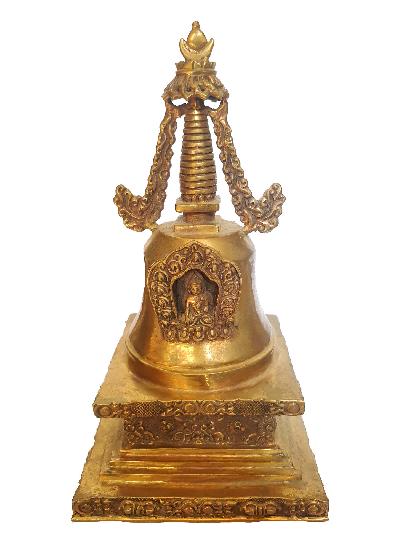
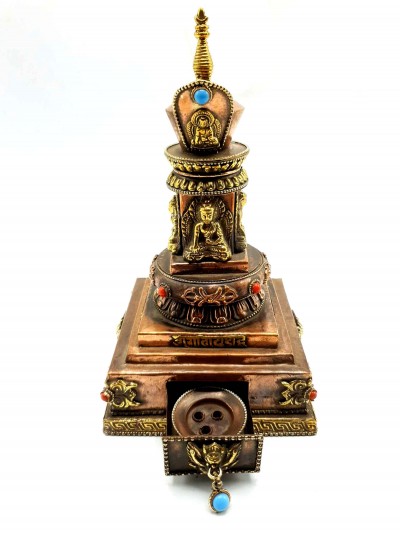
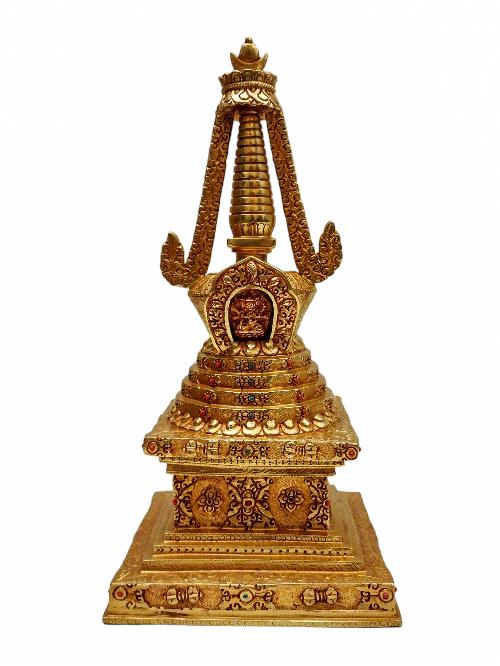
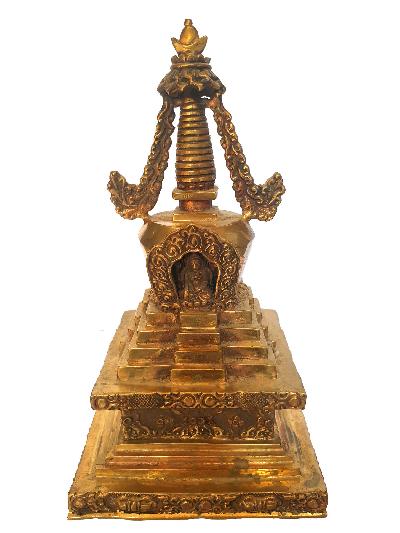
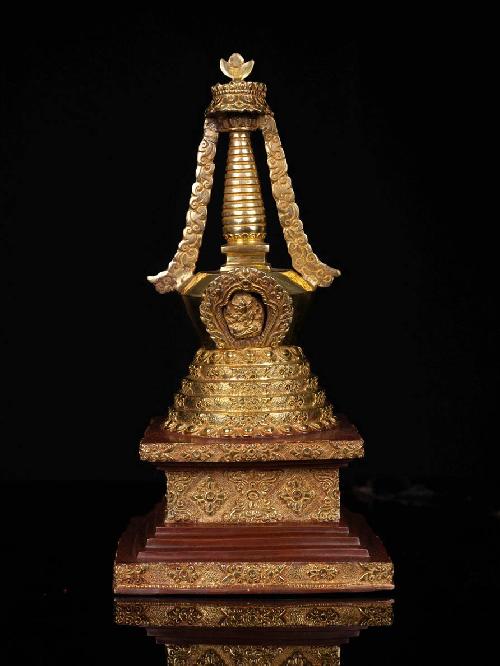
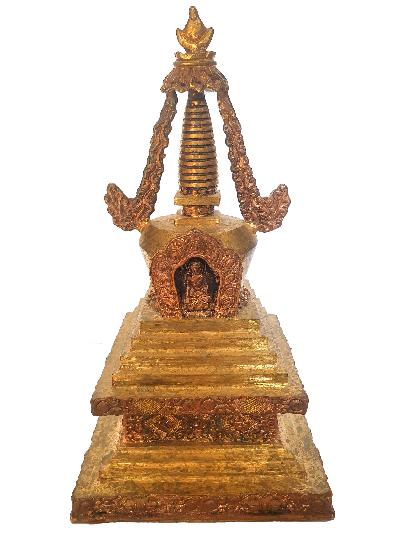
A stupa is a mound-like structure containing Buddhist relics, typically the remains of Buddha, used by Buddhists as a place of worship. The stupa is the oldest Buddhist religious monument and was originally only a simple mound of mud or clay to cover supposed relics of the Buddha (cetiya). After the parinirvana of the Buddha, his remains were cremated and the ashes divided and buried under eight stupas with two further stupas encasing the urn and the embers. Little is known about these early stupas, particularly since it has not been possible to identify the original ten monuments. However, some later stupas, such as at Sarnath and Sanchi, seem to be embellishments of earlier mounds.
The shape of the stupa represents the Buddha, crowned, and sitting in meditation posture on a lion throne. His crown is the top of the spire; his head is the square at the spire's base; his body is the vase shape; his legs are the four steps of the lower terrace, and the base is his throne.
Shipping Calculation
The shipping weight for 1 piece of the product is 4.50 kg, and shipping cost is USD72.00.
Country
Shipping Mode
We normally dispatch orders within 2 to 5 business days. If there are any delays, we will personally inform the buyer about the dispatch date.
We accept Paypal | Credit/Debit Card | Bank Transfer | Money Transfer / Remit Click Here for more Information.
We offer a simple 7-day money-back policy, with the buyer responsible for return shipping. Click Here for more Information.
Stupa :
A stupa is a mound-like structure containing Buddhist relics, typically the remains of Buddha, used by Buddhists as a place of worship. The stupa is the oldest Buddhist religious monument and was originally only a simple mound of mud or clay to cover supposed relics of the Buddha (cetiya). After the parinirvana of the Buddha, his remains were cremated and the ashes divided and buried under eight stupas with two further stupas encasing the urn and the embers. Little is known about these early stupas, particularly since it has not been possible to identify the original ten monuments. However, some later stupas, such as at Sarnath and Sanchi, seem to be embellishments of earlier mounds.
The shape of the stupa represents the Buddha, crowned, and sitting in meditation posture on a lion throne. His crown is the top of the spire; his head is the square at the spire's base; his body is the vase shape; his legs are the four steps of the lower terrace, and the base is his throne.
Amitabha Buddha : Brief Introduction
Amitabha is head of the Lotus Family, one of oldest & significant of the Five Buddha Families. This family represents love, purity, compassion & peace. Amitabha Purelandis a place of infinite bliss & boundless light. He will guide you along a path of simplicity and purity towards such a place where you can find inner contentment. Amitabha will help you overcome addictions and cravings.
Iconography Amitabha Buddha is also one of the five Tathagatas representing the wisdom of discriminating awareness (skt. Pratyavekshanajnana). When discriminating wisdom dawns on us we realize Non-production or non-origination of all things. He also represents purified form of desire.
Amitabha Buddha is red in color. He is represented in the stupa facing to the west. He rides on peacock symbolizing that he can take away the suffering of others just as the peacock eats poisonous plants and yet his tail shines forth.
Amitabha in Sanskrit means immeasurable light or limitless light. He resides in the western land of unlimited bliss (skt. Sukhavati). He is assisted by two Bodhisattvas viz. Avalokiteshvara and Mahasthamaprapta. When he was a bodhisattva he was called Bhikshu Dharmakara. He made vows to establish an adorned land of unlimited bliss to ferry over those living beings who recite his name. On the basis of those vows, any living being who has faith, makes vows and practices diligently will be received by this Buddha and reborn in the pure land of unlimited bliss.
Amitabha Buddha presides over the Bhadrakalpa i.e. Fortunate Aeon. He always exhibits Dhyana mudra. He belongs to the Lotus family. He originates from the seed syllable Hrih. He can be recognized through the symbol of the lotus. With his extensive vows and great compassion this Buddha has ferried over innumerable sentient beings. The recitation of the name of Amitabha Buddha is a common practice in China and Japan. In Tibet too, devotees recite very often the prayer to be reborn in the land of Amitabha Buddha.urity
Commentary The word 'Amitabha' is composed of 2 syllables. Amita-[Skt.] translates as infinite & -bha universal life or simply the universe. Related Sanskrit words include bha-va asin Bhavachakra & Bha-gavad as in Bhagavad Gita. Amitabha is often translated as Boundless Light which is taken to be the boundless Universe. Amitabha realised a Pure Land called Sukhavati which meanspossessinghappinessin Sanskrit. Sukhavati is situated in the uttermost west beyond the bounds of rational understanding. By the power of his vows he made it possible for all who call upon him to be reborn into this land, there to undergo instruction by him in the dharma and ultimately become bodhisattvas & Buddhas. Amitabha is one of the five Transcendent Buddhas emanated from the primeval 'Adi' Buddha Vajrdhara. Each of the transcendent Buddhas has arisen to help us overcome the five obstructions [Skt. Kleshas] to our spiritual growth and each is the Head of a Family. The Sanskrit word Klesha means poison in the sense of curruption. For this reason the transcendent Buddhas are called Wisdom Buddhas; they possess the wisdom to overcome viz. transcend the five obstructions are greed, hatred, delusion, jealousy & pride. Amitabha is formed to help us overcome greed [often expressed as desire]. Greed is conceived of as a thirst [Skt. Tanha] or appetite for the destructive things that harm us such as smoking, alcohol & selfishness. The transcendent Buddhas are sometimecalled the Meditation [Skt. Dhyana] Buddhas as people meditate on their wisdoms to overcome the five obstructions to spiritual growth to anable us to reach a higher level of understanding.
Mantra of Amitabha Buddha
Oṃ Amideva Hrīḥ
Read More . . .
Silver and Chocolate Oxidized
The Stupa features a captivating combination of partly silver plating and dark oxidation. This unique finishing technique combines the lustrous shine of silver with the rich, deep tones achieved through oxidation. In the process of creating this finish, selected areas of the Stupa are expertly silver-plated, creating a radiant and reflective surface that catches the light. The remaining areas are intentionally oxidized, resulting in a darkened patina that adds depth and character to the piece.
The contrast between the silver plating and dark oxidation creates a visually striking effect, enhancing the intricate details and contours of the Stupa. This combination of techniques not only adds visual interest but also provides a sense of antiquity and time-worn charm to the statue.
The partly silver plating and dark oxidation finishing is a testament to the craftsmanship and artistic vision of the creators. It showcases their ability to harmonize different elements, resulting in a distinctive and captivating aesthetic for the Stupa.
Read More . . .
Lost-Wax System
This Stupa of Stupa is made by the process of the Lost Wax system. This is a very complicated, time consuming and historic process of making metal sculptures.Which is why it is sometimes called Precision Casting as well. Hence the sculptures made by this process are comparatively expensive. There are many new, advanced and less time consuming methods of casting metal sculptures available as well. But due to the benefits provided by the traditional lost wax system in quality control and customization, we prefer the Loss wax system over Ceramic molding, or sand casting to make our Stupa.
Below we have tried to illustrate the process of making a loss wax system statue:
The method of metal casting in which a molten metal is poured into a mold that has been created by means of a wax model. Once the mold is made, the wax model is melted and drained away. Bronze statues come to life differently than marble statues. Instead of carving a block or marble, the bronze artist uses the lost-wax technique to make a series of molds, and then pours melted bronze into the final mold to create the sculpture. This method has been around since 4500 BCE.
There are few important steps in lost wax casting process :
Step 1: Sculpting ( It all starts in the studio with an idea, Then figuring out how to realize the vision in clay.)
Step 2: Mold Making.
Step 3: Wax Pouring.
Step 5: Wax Spruing.
Step 6: Shell Dipping.
Step 7: Bronze Pouring.
Interestingly enough Loss wax process is also called Investment casting because after layers have been formed and dried, the wax is melted out of the ceramic tree by using steam (120?C) in an autoclave. This is why it is called "lost wax casting". The majority of the molten wax which can then be regenerated and is reusable.
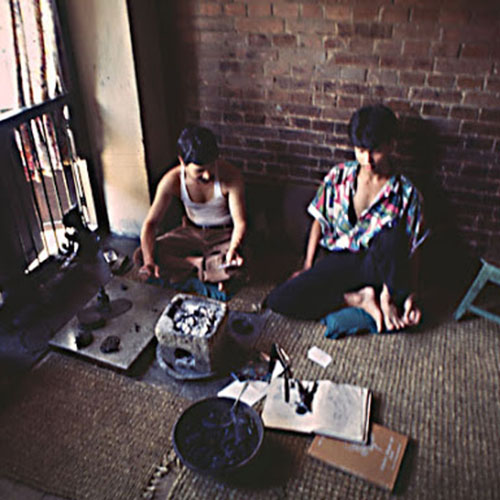
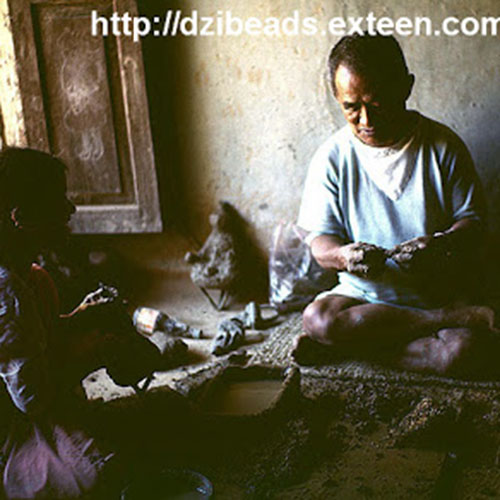
Before Making statue :At work room making the wax models.
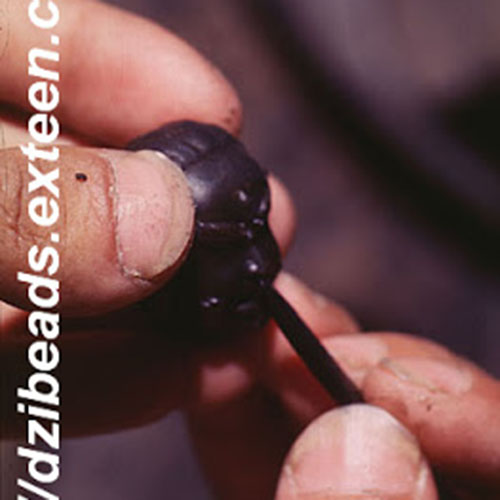
Softening a piece of wax over a brazier.
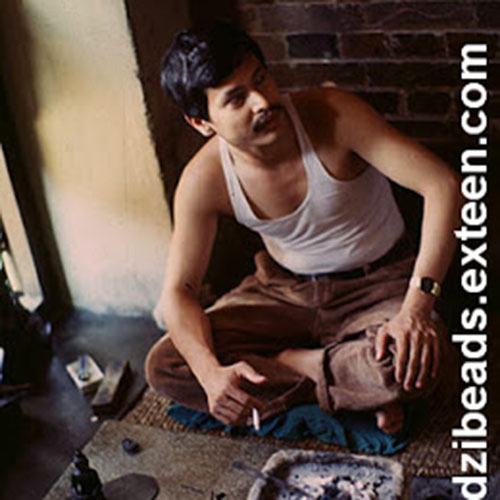
Relaxing after softening the wax The working environment with works in progress.
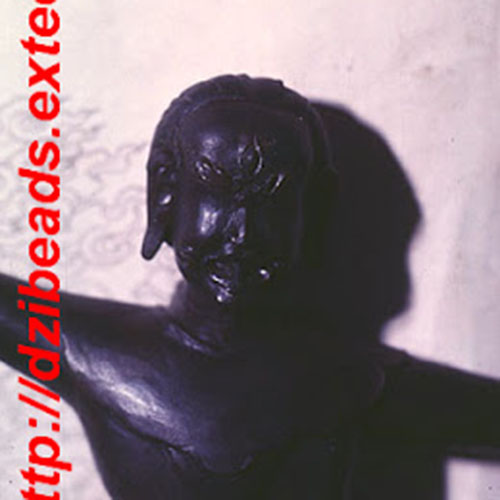
Working the face of an Ekajata wax model.
Working the face of wax model.Using a modeling tool to form the face of Ekajata.
Deatail of wax model
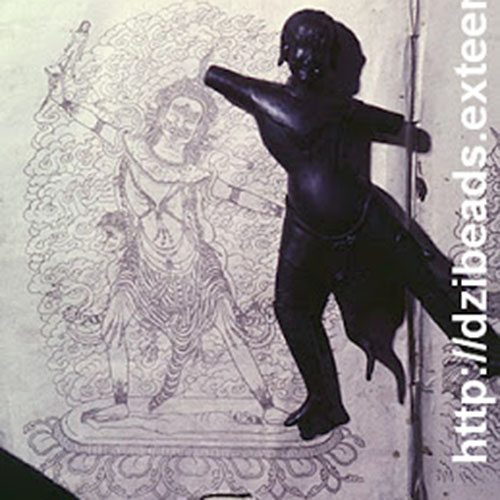
The design for Ekajata compared to the Tibetan book on which it was based.Statues Maker Are master in buddhism .
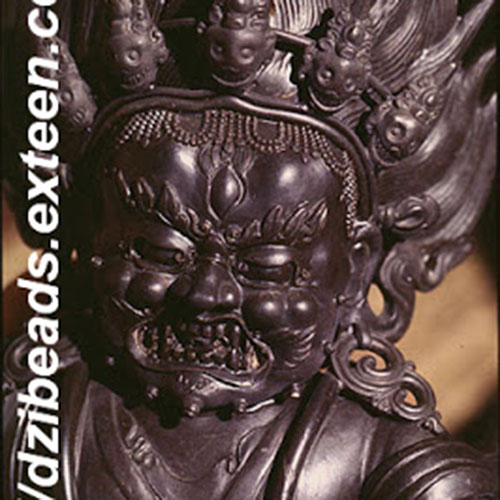
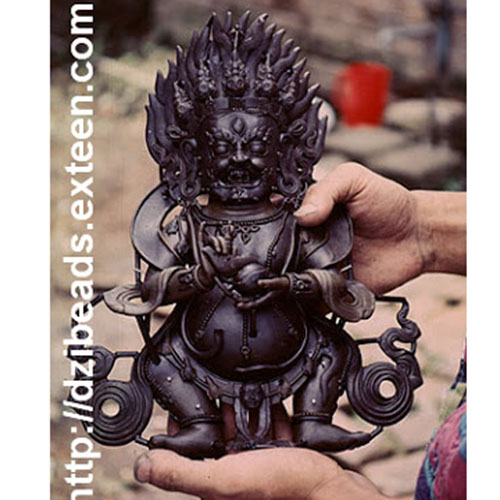
Detail of A partially finished Candamaharoshana (Acala) wax figure made in the Tibetan style.
A finished wax image of Mahakala.
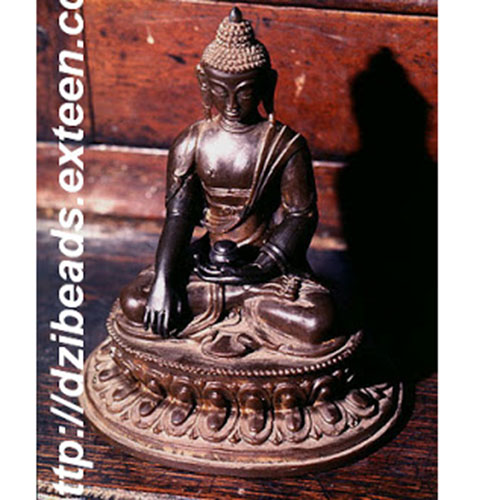
Anthor Finished Wax Model of Shakyamuni Buddha
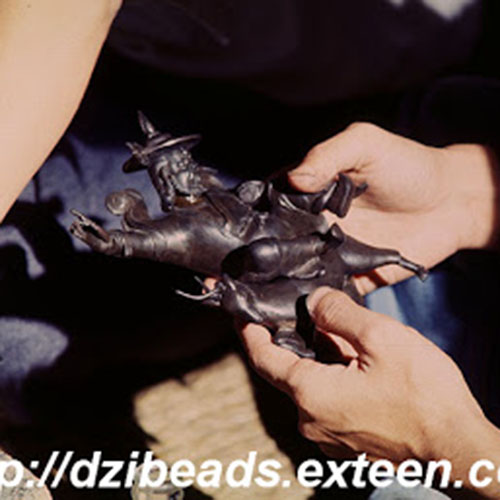
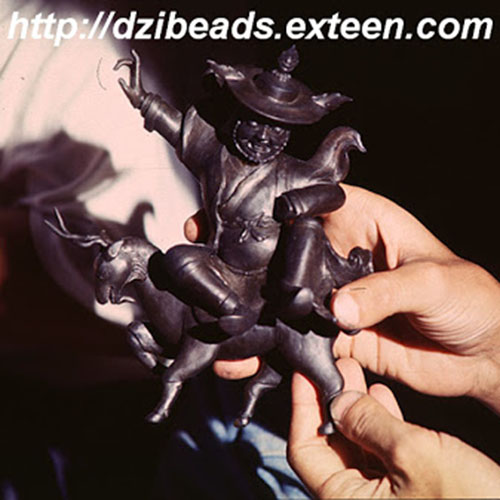
One of the modelers working in the room shows the Pehar image on which he is working.
The artist showed how the goat , which had been completed earlier, fits under the image. ,
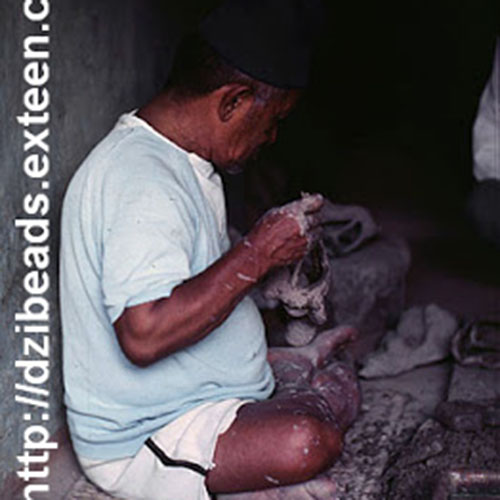
Tej Jyoti Shakya and his wife, Nani Maya Shakya Covering the wax model in a mixture of clay and dung
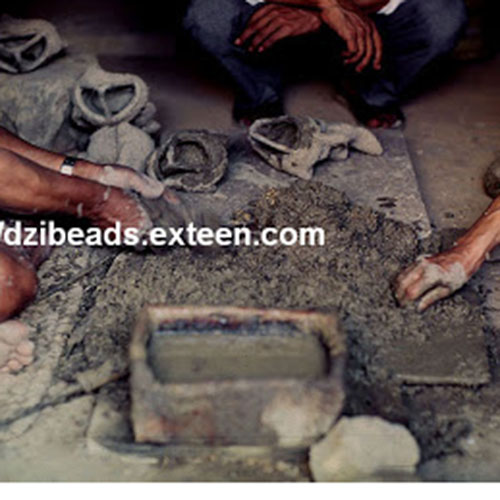
Pressing the mixture of clay and dung around the wax image.
The board with the clay and dung mixture ready for use.
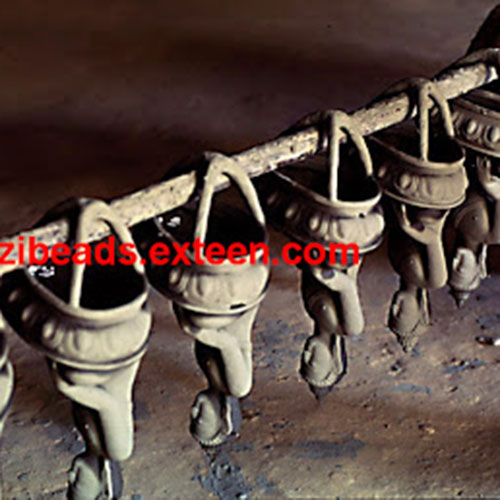
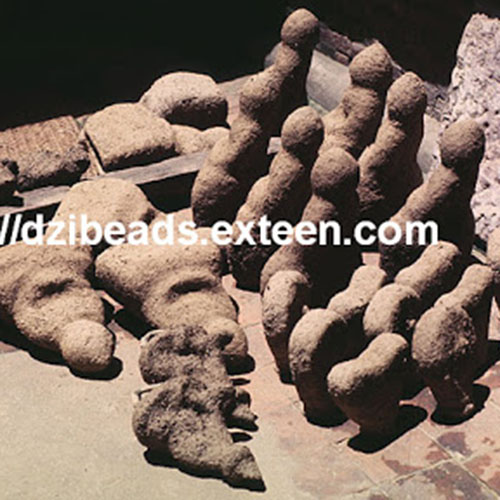
Model Pieces drying after the initial (dipped) thin layer of fine clay.
Clay-covered model pieces drying in the sun.
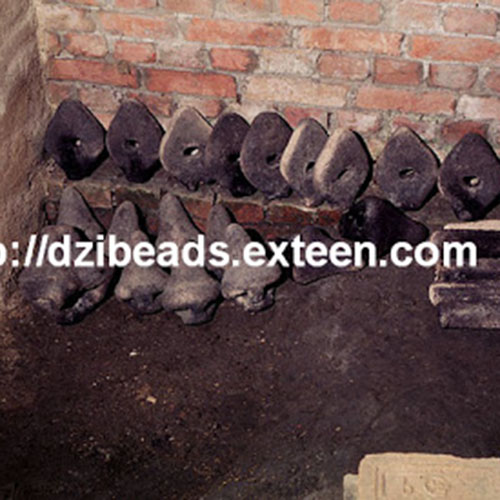
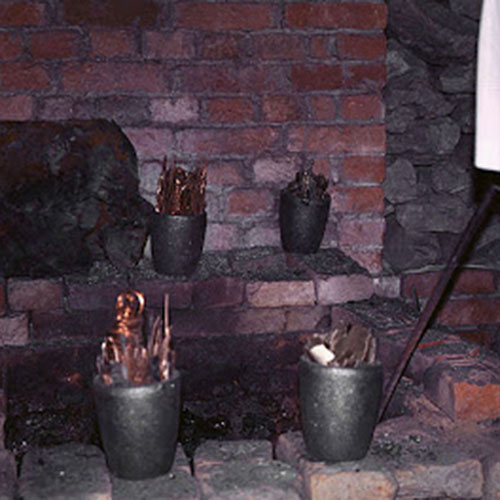
Molds waiting to be put into the burnout furnace
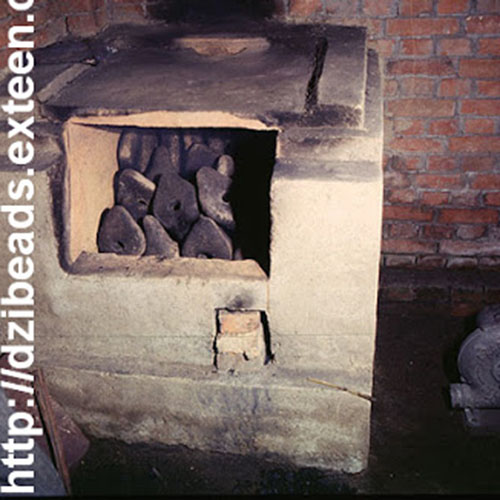
The same molds, seen in the previous image, in the burnout furnace
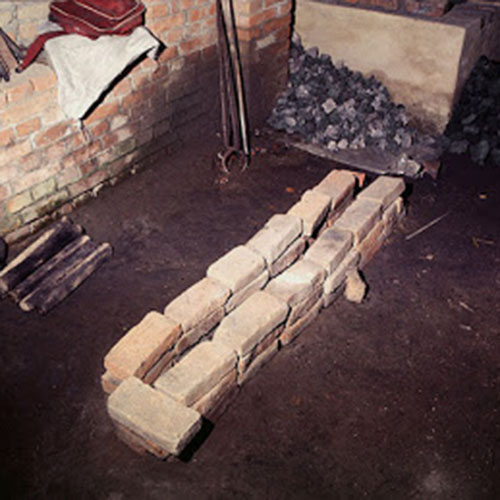
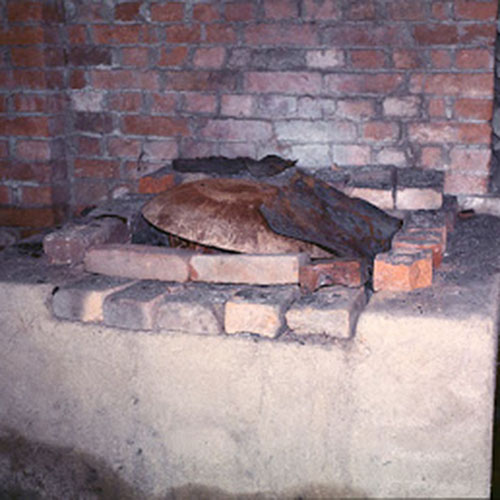
The double row of refractory bricks used to support the heated molds during casting.
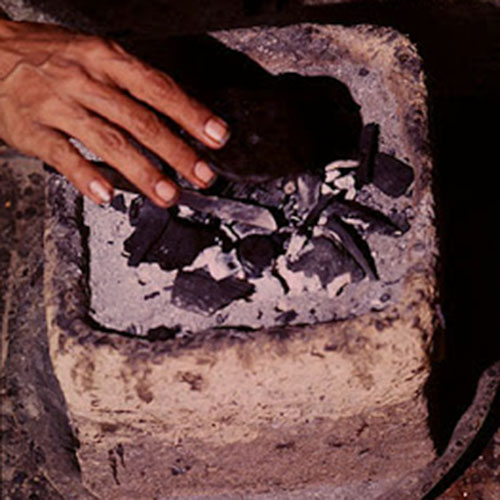
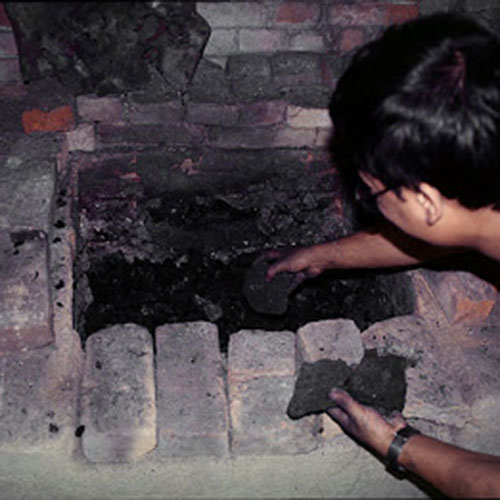
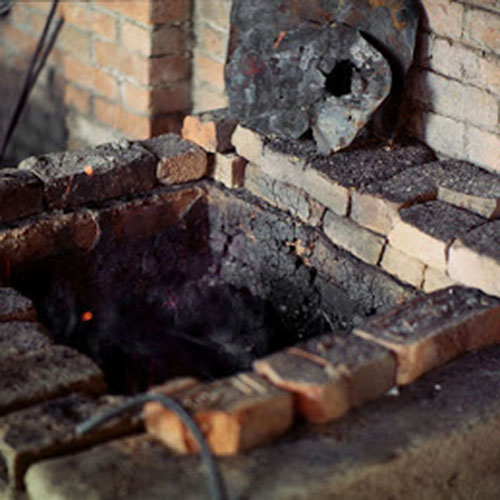
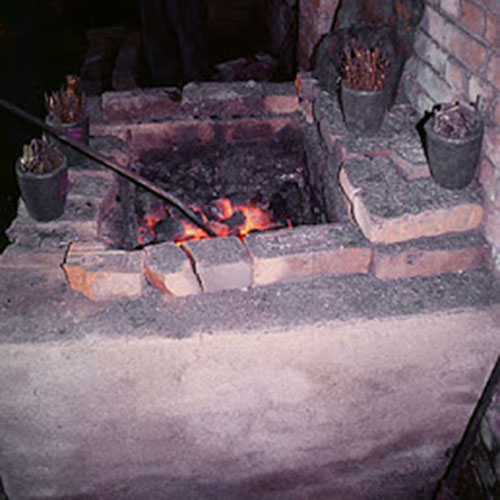
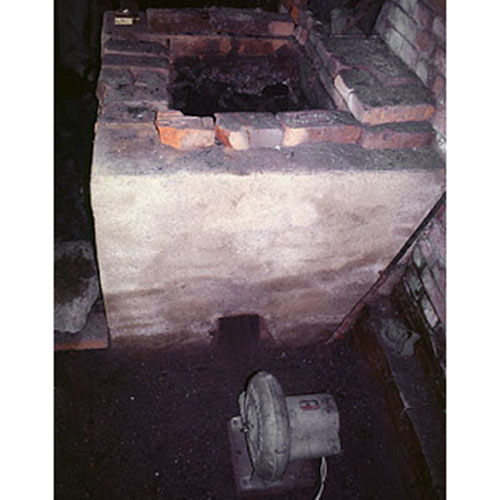
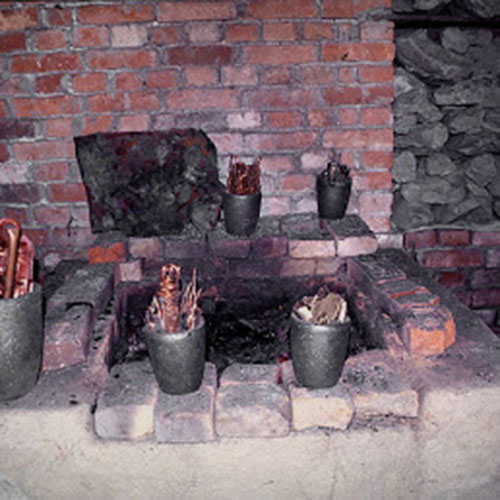
The melting furnace and a pile of coke used for melting the metals. Laying the bed of coke in the melting furnace.
The first ignition of the coke.
Checking the coke bed.
The electric blower used to force air into the melting furnace
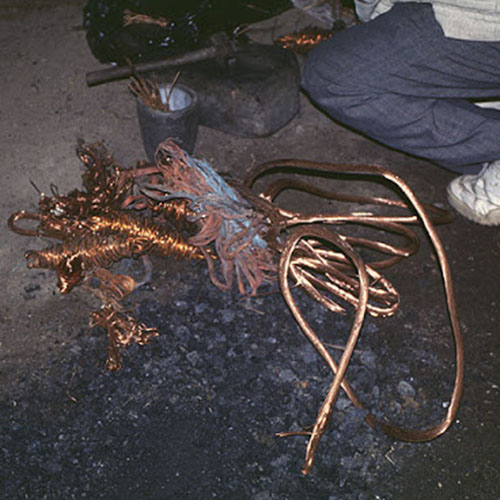
Beginning to fill the crucibles with scrap copper.
Preparing the bed of burning coke to receive the crucibles
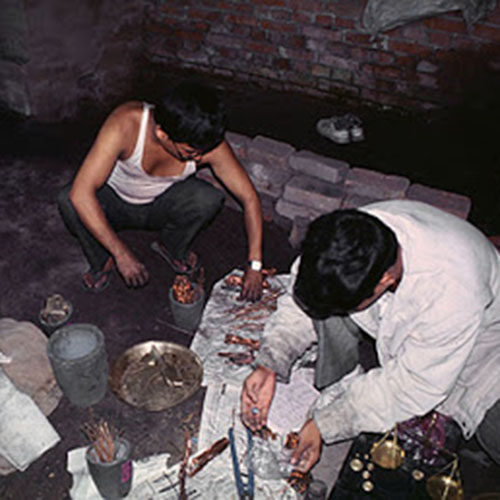
Sorting various metals used in the alloys.
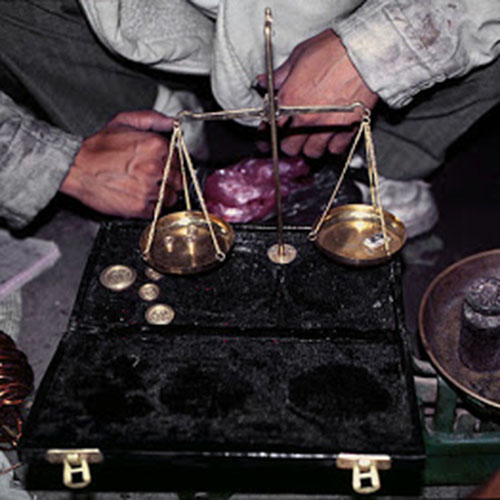
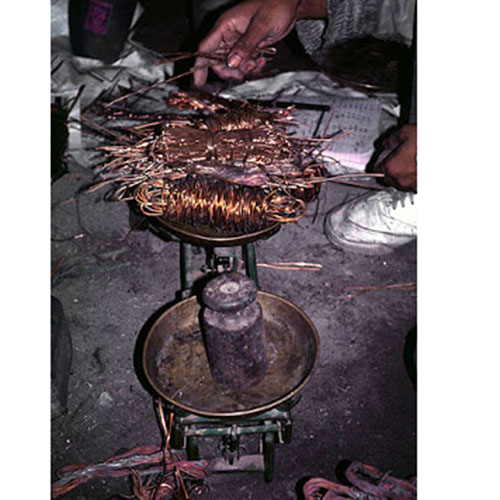
Weighing precious metals that are used in the alloys
Weighing copper from Singapore to achieve a correct alloy.
Different sizes of crucibles and various types of metals to be cast in this melt.
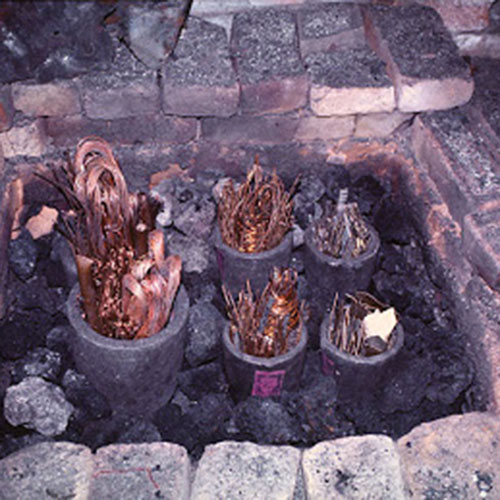
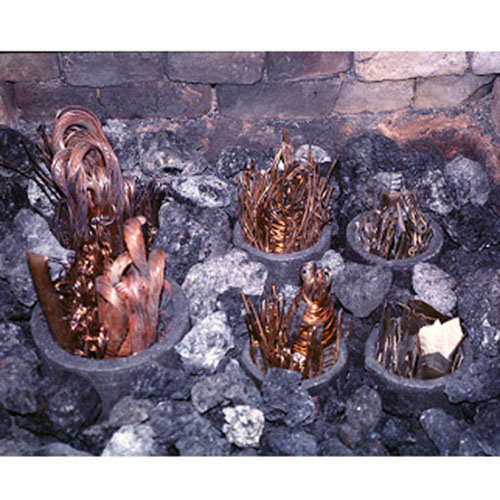
Placing the crucibles in the bed of coke filled with metal are in place.
After the crucibles are in place, more coke is piled around them.
The crucibles are covered with scrap metal to hold in the heat.
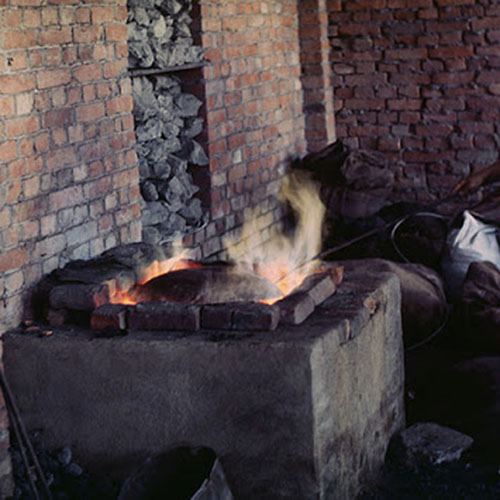
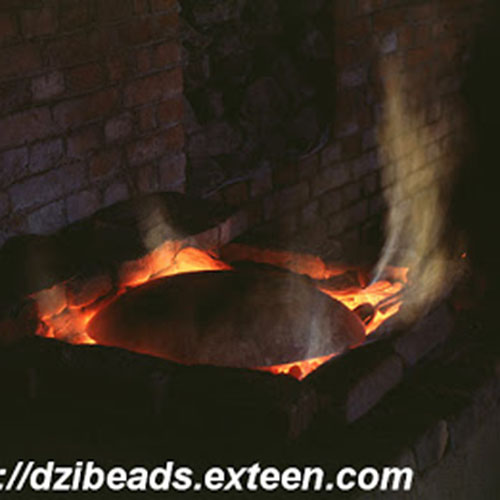
The electric fan is then connected.Soon a very hot flame is produced.
The entire furnace temperature goes up to about 1800 -1900 degrees.
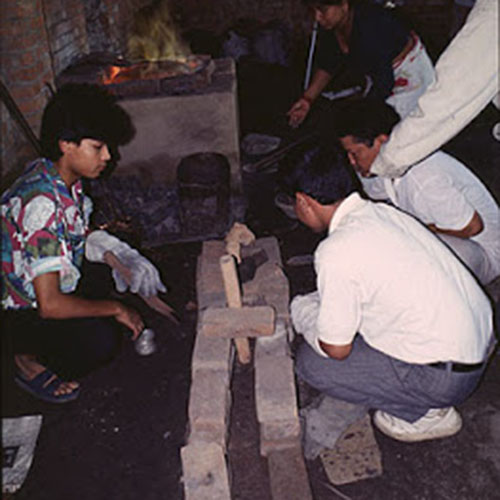
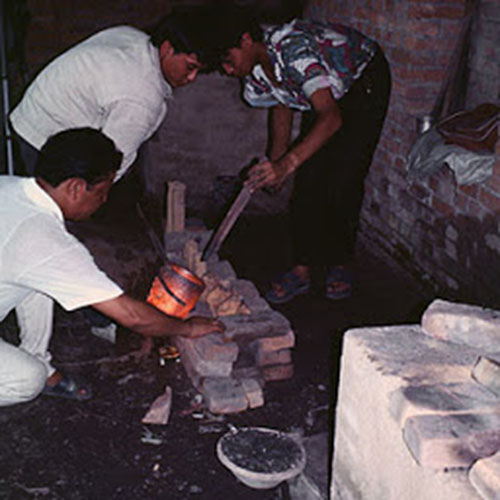
Setting up molds in between the refractory bricks to receive the molten metal. Handling the molds with asbestos gloves and bracing them with fragments of bricks.
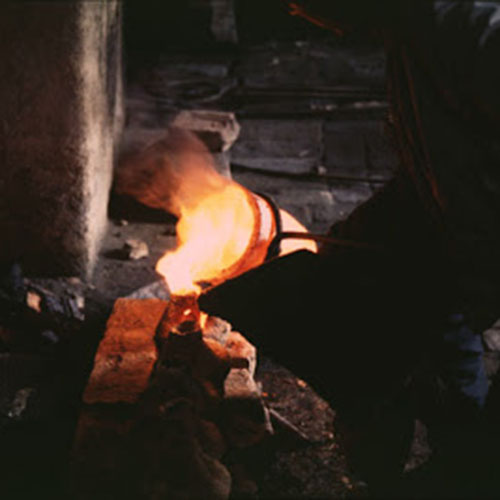
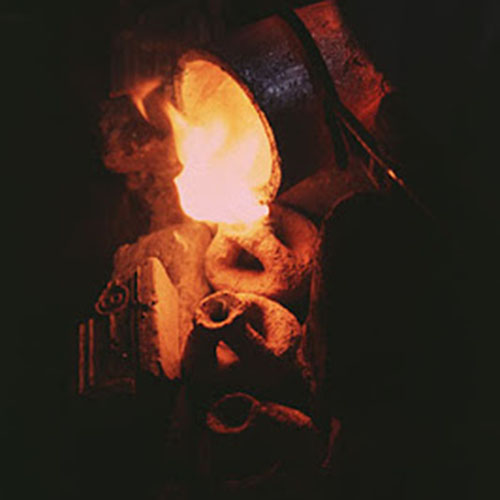
Pouring the molten metal into the base of a mold
Another view of the artists pouring the molten metal.Detailed view showing the molten metal being poured into the sprues.
Preparing to lift and pour molten metal from one of the larger crucibles.
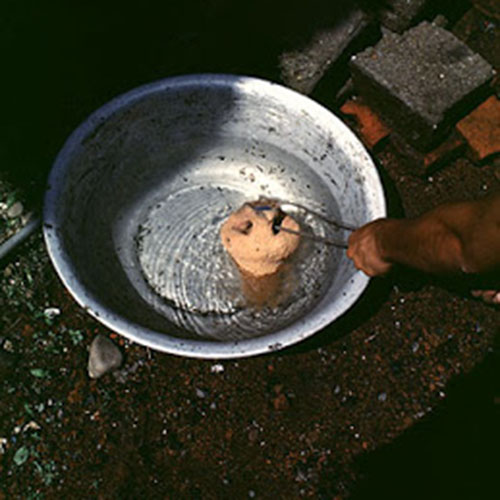
Cooling a mold containing the recently poured metal.
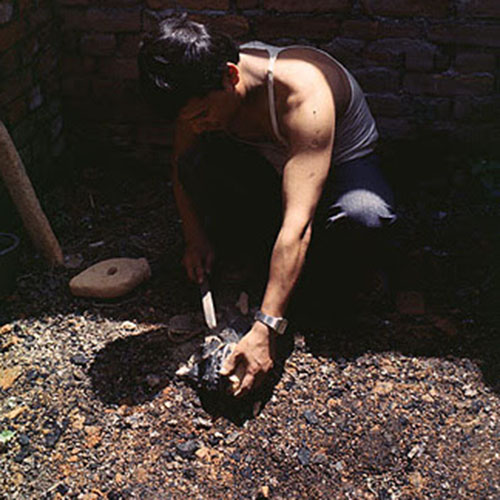
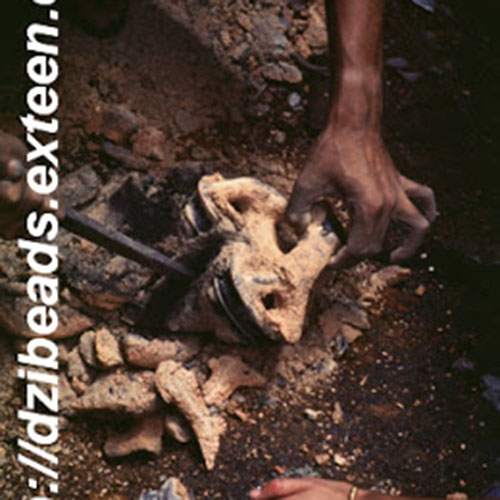
Beginning to break away the clay mold from the metal casting. The mold breaks away revealing the metal image inside
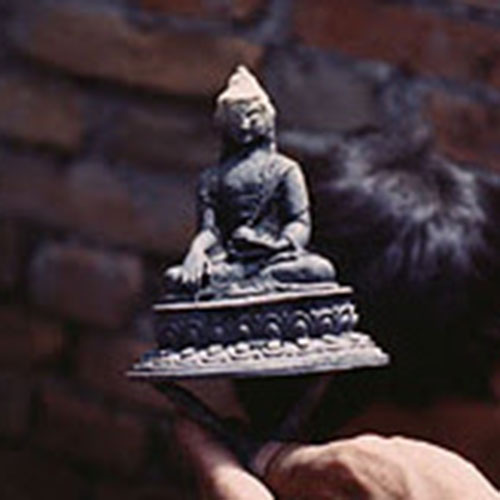
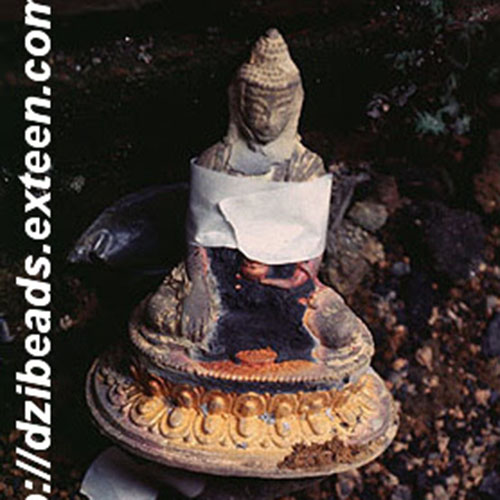
The first metal image from the day's work.
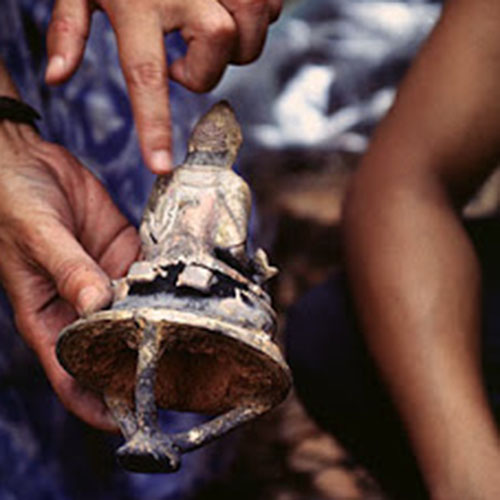
Examining the image for flaws
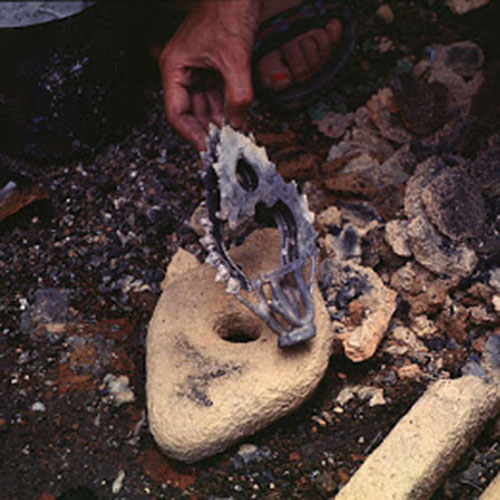
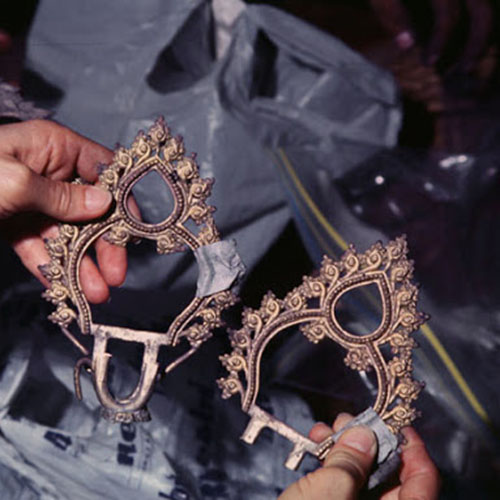
Two auras (prabhamandalas), one that cast perfectly and one (in front) that only partially filled.
Opening more molds
Researchers mark specific metal images for future identification.
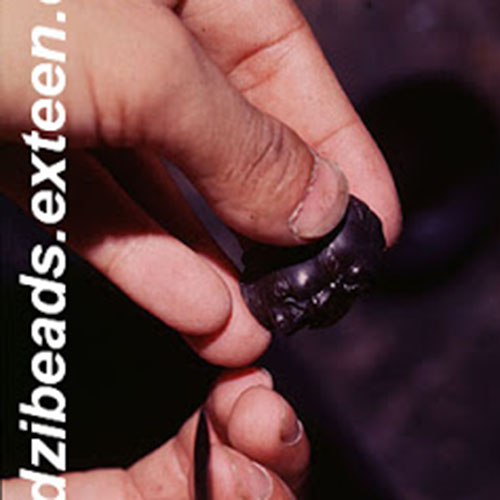
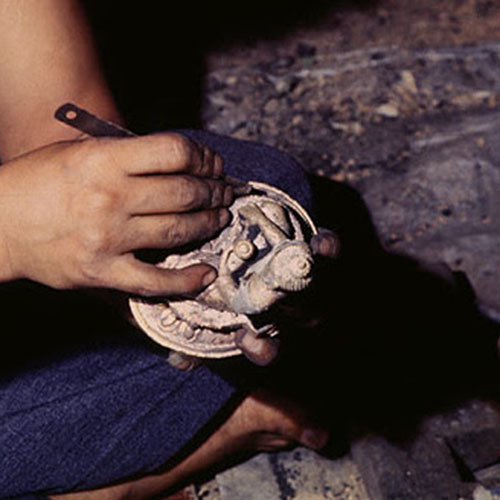
Cleaning the details of the image with a metal tool.
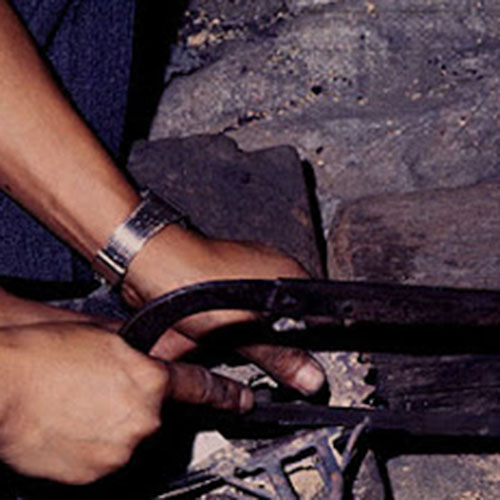
Sawing off the sprues from Aura image. The sprue metal will be reused in future castings.
Two auras that worked perfectly. The one on the right has been cut off of the sprues, while the one on the left still has the sprues attached.
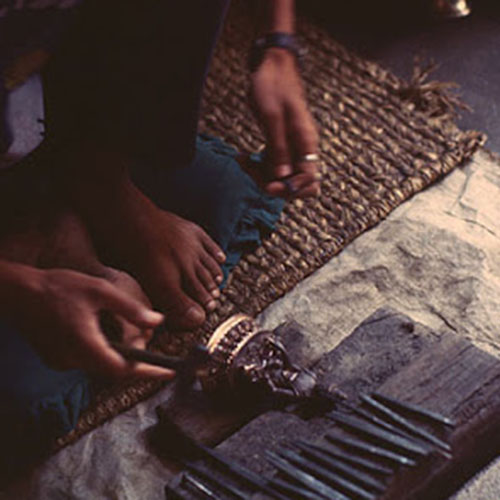
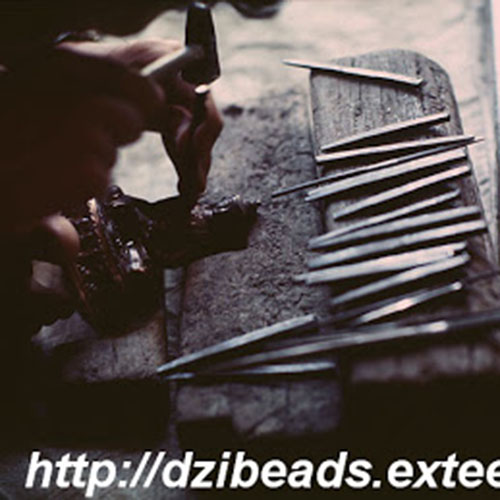
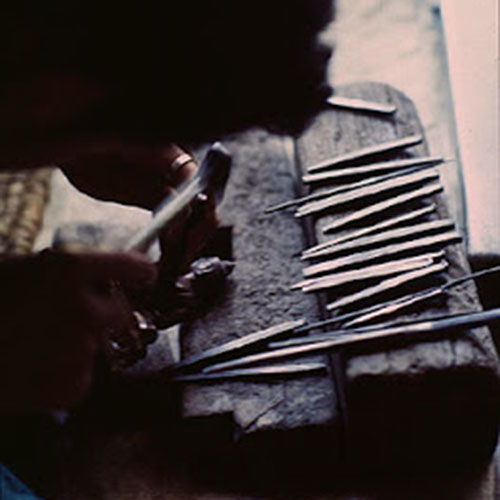
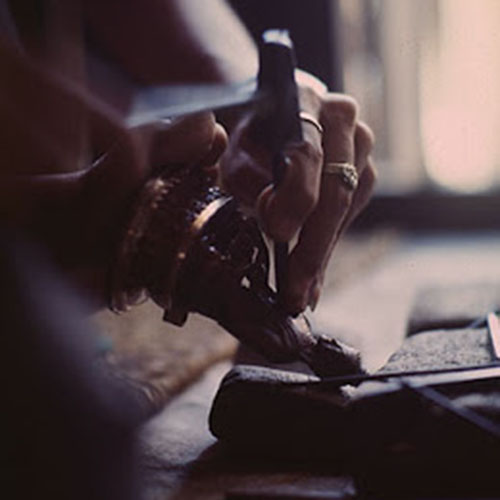
The finishing specialist begins the finishing process with a set of tools, including a small hammer. to give more detail
The entire surface of the image will be gently hammered to a final, almost polished finish.
The finisher's tools and the work in progress
Finishing work on an image of the Buddha.
Hammering the chest of an image that is being held against the work block
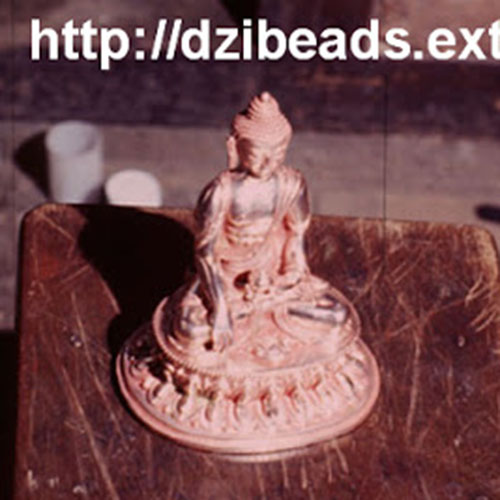
A Buddha image hammered and chased to the final, detailed finish.
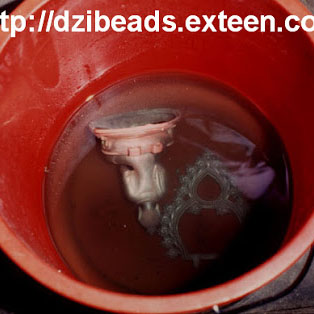
Cleaning in a very mild acid bath. The image and prabhamandala are placed in a final acidic bath to make sure the surface is absolutely clean.
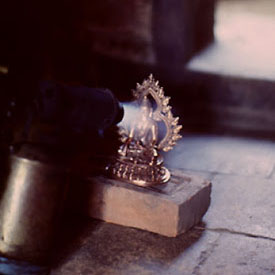
Drying the image with a blow torch.
Read More . . .
Iconography :
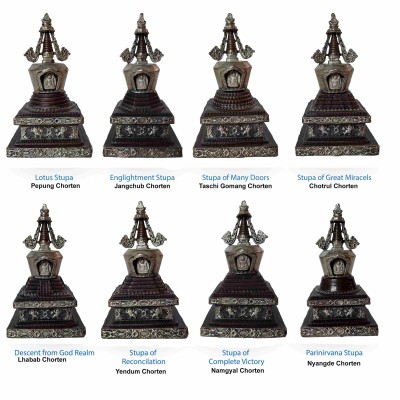
There are eight different kinds of stupas in Tibetan Buddhism, each referring to major events in the Buddha's life. Lotus Blossom Stupa
Also known as Stupa of Heaped Lotuses or Birth of the Sugata Stupa, this stupa refers to the birth of the Buddha. "At birth Buddha took seven steps in each of the four directions" (East, South, West and North). In each direction lotuses sprang, symbolizing the Four Immeasurables: love, compassion, joy and equanimity. The four steps of the basis of this stupa is circular, and it is decorated with lotus-petal designs. Occasionally, seven heaped lotus steps are constructed. These refer to the seven first steps of the Buddha.
Enlightenment Stupa
Also known as the Stupa of the Conquest of Mara. This stupa symbolizes the 35-year-old Buddha's attainment of enlightenment under the bodhi tree in Bodh Gaya, where he conquered worldly temptations and attacks manifesting in the form of Mara.
Stupa of Many Doors
Also known as the Stupa of Many Gates. After reaching enlightenment, the Buddha taught his first students in a deer-park near Sarnath. The series of doors on each side of the steps represent the first teachings: the Four Noble Truths, the Six Perfections, the Noble Eightfold Path and the Twelve Links in the Chain of Dependent Origination.
Stupa of Descent from the God Realm
At 42 years old, Buddha spent a summer retreat in Tushita Heaven, where his mother had taken rebirth. In order to repay her kindness he taught the dharma to her reincarnation. Local inhabitants built a stupa like this in Sankasya in order to commemorate this event. This stupa is characterized by having a central projection at each side containing a triple ladder or steps.
Stupa of Great Miracles
Also known as Stupa of Conquest of the Tirthikas. This stupa refers to various miracles performed by the Buddha when he was 50 years old. Legend claims that he overpowered maras and heretics by engaging them in intellectual arguments and also by performing miracles. This stupa was raised by the Lichavi kingdom to commemorate the event.
Stupa of Reconciliation
This stupa commemorates the Buddha's resolution of a dispute among the sangha. A stupa in this design was built in the kingdom of Magadha, where the reconciliation occurred. It has four octagonal steps with equal sides.
Stupa of Complete Victory
This stupa commemorates Buddha's successful prolonging of his life by three months. It has only three steps, which are circular and unadorned.
Stupa of Nirvana
This stupa refers to the death of the Buddha, when he was 80 years old. It symbolizes the Buddha's complete absorption into the highest state of mind. It is bell-shaped and usually not ornamented.
Inside The Stupa :
All stupas contain a treasury filled with various objects. Small offerings called Tsa-Tsas fill a major part of the treasury. Creation of various types of Tsa-Tsas is a ceremony itself. Mantras written on paper are rolled into thin rolls, and put into these small clay stupas. Filling the treasury, one layer of Tsa-Tsas are placed, and the empty space between is filled with dry sand. On the new surface appearing, another layer is made, until the entire space of a treasury is full.
The number of Tsa-Tsas are dependent on the size of both the treasury and Tsa-Tsa, since it should be completely filled. For example, the Kalachakra stupa in southern Spain has approximately 14 000 Tsa-Tsas within.
Jewellery and other "precious" objects are also placed in the treasury. It is not necessary that the jewellery be expensive, since it is the symbolic value that is important, not the market price. It is believed that the more objects placed into the stupa, the stronger the energy of the Stupa will be
At Handicraft Seller, we believe in providing a seamless and user-friendly experience to our valued customers. While our website is not an online shopping platform, we have incorporated a shopping cart system to simplify the process of sending us your inquiries. Please follow the steps below to place your order:
Step 1: Browsing the Selection Explore our website to discover a delightful array of authentic Nepali handicraft products. Click on the products you are interested in to view detailed descriptions and images.
Step 2: Adding Items to Your Inquiry Cart To express your interest in a particular product, click the "Add to Inquiry Cart" button associated with that item. The shopping cart will accumulate your selected products, providing a convenient way to organize your choices.
Step 3: Reviewing Your Inquiry Cart Once you have finished selecting the items you wish to inquire about, review your "Inquiry Cart" to ensure accuracy.
Step 4: Sending Your Inquiries Proceed to submit your inquiries by clicking the "Submit Inquiry" button. A form will prompt you to provide your contact details, the selected products, and any specific queries you may have.
Step 5: Communicating through Email As we do not have an automated payment system, we will conduct the business process through email. Our team will review your inquiries and respond via email, offering further assistance and guidance.
Step 6: Clarifying Details and Finalizing Your Order Engage in direct communication with our team to clarify any additional information or customization requests. Once you are satisfied with the details, we will provide you with payment instructions and confirm the order.
Step 7: Completing the Transaction Make the payment through the designated method as provided in the email. After receiving the payment, we will process your order and prepare it for shipment.
Step 8: Shipping and Delivery We offer worldwide shipping for all our products. Once your order is dispatched, we will provide you with shipping details and tracking information.
Step 9: Receiving and Enjoying Your Handicrafts Wait for your exquisite handicrafts to arrive at your doorstep. Unpack and revel in the beauty and craftsmanship of your chosen Nepali treasures.
Contacting Us If you encounter any complications while submitting your inquiries or need further assistance, please feel free to contact us. Preferably, reach out to us through WhatsApp or email for prompt responses and support.
We hope this straightforward ordering process ensures a delightful and satisfying experience with Handicraft Seller. Thank you for choosing us to connect you with the rich heritage of Nepali handicrafts.
Return Policy
We have a 7 days money back policy but buyer have to pay the return shipping charges.
Shipping
Shipping cost is calculated, based on the shipping weight of the products ordered. THe normal Shipping cost is US$25 for upto 0.5 kgs weight
We ship Worldwide, Except Russia and India.
The deliver duration varies for international Shipping location. We normally dispatch the product in 2 -3 business days. Else Buyer will be infromed Personally about the shipping.
This is not a direct shopping website. So no payments are needed for placing an order. Please feel free to send us an order for the product you are interested in, mentioning the approximate quantity. Based on which we will send you a wholesale price quotation.
![Buddhist Handmade Statue Of Stupa, [silver And Chocolate Oxidized], With [amitabha Buddha]](https://www.handmadeexpo.com/pics/product/28327.jpg)

![Buddhist Handmade Statue Of Stupa, [silver And Chocolate Oxidized], With [amitabha Buddha]](https://www.handmadeexpo.com/pics/product/thumb/28327.jpg)
![Buddhist Handmade Statue Of Stupa, [silver And Chocolate Oxidized], With [amitabha Buddha]](https://www.handmadeexpo.com/pics/product/thumb/28327_0.jpg)
![Buddhist Handmade Statue Of Stupa, [silver And Chocolate Oxidized], With [amitabha Buddha]](https://www.handmadeexpo.com/pics/product/thumb/28327_1.jpg)
![Buddhist Handmade Statue Of Stupa, [silver And Chocolate Oxidized], With [amitabha Buddha]](https://www.handmadeexpo.com/pics/product/thumb/28327_2.jpg)