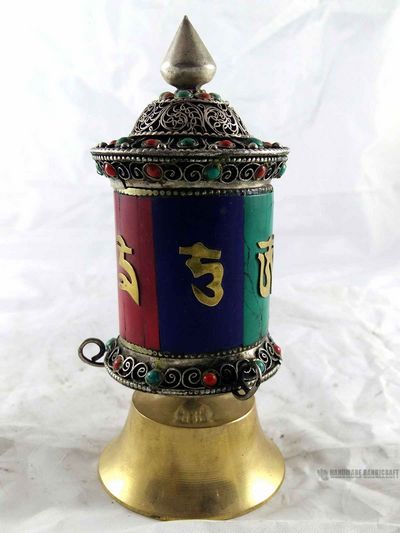
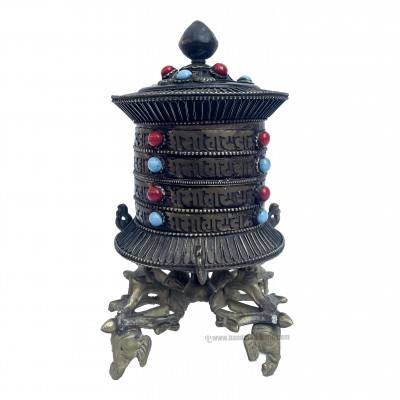
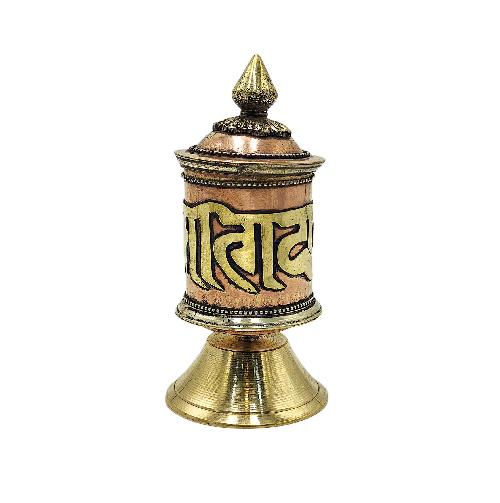
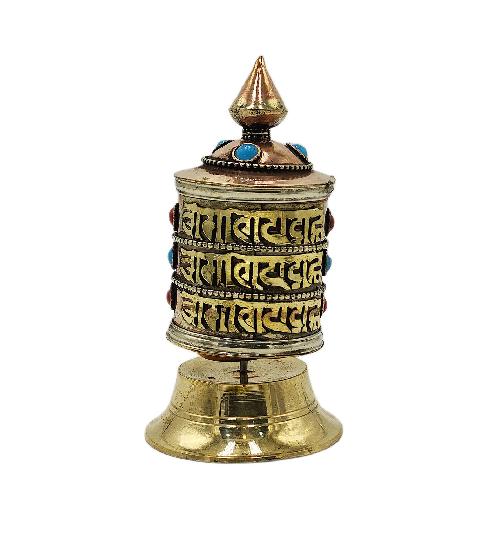
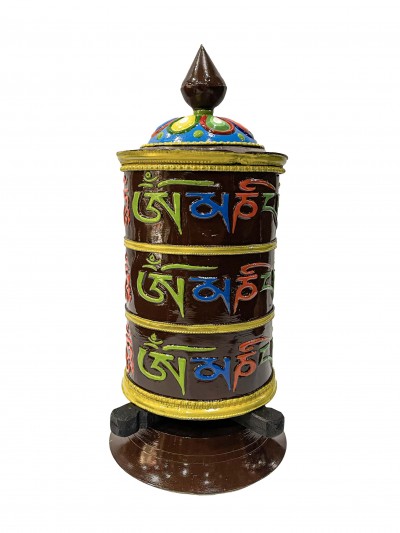
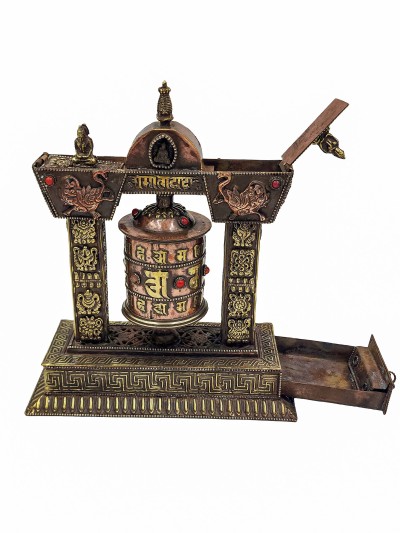
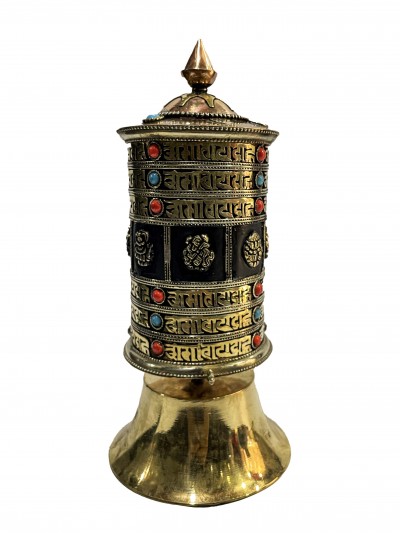
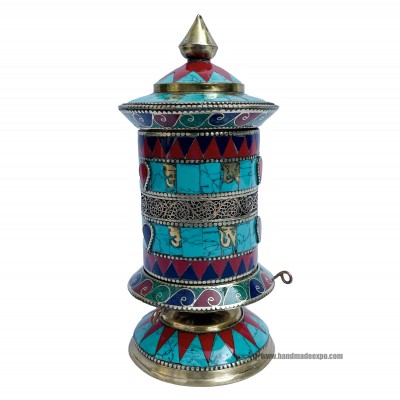
A prayer wheel is a cylindrical wheel on a spindle made from metal, wood, stone, leather, or coarse cotton. Traditionally, the mantra Om Mani Padme Hum is written in the Newari language of Nepal, on the outside of the wheel. Also sometimes depicted are Dakinis, Protectors, and very often the 8 auspicious symbols Ashtamangala. At the core of the cylinder is a "Life Tree" often made of wood or metal with certain mantras written on or wrapped around it. Many thousands (or in the case of larger prayer wheels, millions) of mantras are then wrapped around this life tree. The Mantra Om Mani Padme Hum is most commonly used, but other mantras may be used as well. According to the Tibetan Buddhist tradition based on the lineage texts regarding prayer wheels, spinning such a wheel will have much the same meritorious effect as orally reciting the prayers.
Stupa : Brief Introduction
A stupa is a mound-like structure containing Buddhist relics, typically the remains of Buddha, used by Buddhists as a place of worship. The stupa is the oldest Buddhist religious monument and was originally only a simple mound of mud or clay to cover supposed relics of the Buddha (cetiya). After the parinirvana of the Buddha, his remains were cremated and the ashes divided and buried under eight stupas with two further stupas encasing the urn and the embers. Little is known about these early stupas, particularly since it has not been possible to identify the original ten monuments. However, some later stupas, such as at Sarnath and Sanchi, seem to be embellishments of earlier mounds.
The shape of the stupa represents the Buddha, crowned, and sitting in meditation posture on a lion throne. His crown is the top of the spire; his head is the square at the spire's base; his body is the vase shape; his legs are the four steps of the lower terrace, and the base is his throne.
Iconography There are eight different kinds of stupas in Tibetan Buddhism, each referring to major events in the Buddha's life. Lotus Blossom Stupa
Also known as Stupa of Heaped Lotuses or Birth of the Sugata Stupa, this stupa refers to the birth of the Buddha. "At birth Buddha took seven steps in each of the four directions" (East, South, West and North). In each direction lotuses sprang, symbolizing the Four Immeasurables: love, compassion, joy and equanimity. The four steps of the basis of this stupa is circular, and it is decorated with lotus-petal designs. Occasionally, seven heaped lotus steps are constructed. These refer to the seven first steps of the Buddha.
Enlightenment Stupa
Also known as the Stupa of the Conquest of Mara. This stupa symbolizes the 35-year-old Buddha's attainment of enlightenment under the bodhi tree in Bodh Gaya, where he conquered worldly temptations and attacks manifesting in the form of Mara.
Stupa of Many Doors
Also known as the Stupa of Many Gates. After reaching enlightenment, the Buddha taught his first students in a deer-park near Sarnath. The series of doors on each side of the steps represent the first teachings: the Four Noble Truths, the Six Perfections, the Noble Eightfold Path and the Twelve Links in the Chain of Dependent Origination.
Stupa of Descent from the God Realm
At 42 years old, Buddha spent a summer retreat in Tushita Heaven, where his mother had taken rebirth. In order to repay her kindness he taught the dharma to her reincarnation. Local inhabitants built a stupa like this in Sankasya in order to commemorate this event. This stupa is characterized by having a central projection at each side containing a triple ladder or steps.
Stupa of Great Miracles
Also known as Stupa of Conquest of the Tirthikas. This stupa refers to various miracles performed by the Buddha when he was 50 years old. Legend claims that he overpowered maras and heretics by engaging them in intellectual arguments and also by performing miracles. This stupa was raised by the Lichavi kingdom to commemorate the event.
Stupa of Reconciliation
This stupa commemorates the Buddha's resolution of a dispute among the sangha. A stupa in this design was built in the kingdom of Magadha, where the reconciliation occurred. It has four octagonal steps with equal sides.
Stupa of Complete Victory
This stupa commemorates Buddha's successful prolonging of his life by three months. It has only three steps, which are circular and unadorned.
Stupa of Nirvana
This stupa refers to the death of the Buddha, when he was 80 years old. It symbolizes the Buddha's complete absorption into the highest state of mind. It is bell-shaped and usually not ornamented.
Inside The Stupa All stupas contain a treasury filled with various objects. Small offerings called Tsa-Tsas fill a major part of the treasury. Creation of various types of Tsa-Tsas is a ceremony itself. Mantras written on paper are rolled into thin rolls, and put into these small clay stupas. Filling the treasury, one layer of Tsa-Tsas are placed, and the empty space between is filled with dry sand. On the new surface appearing, another layer is made, until the entire space of a treasury is full.
The number of Tsa-Tsas are dependent on the size of both the treasury and Tsa-Tsa, since it should be completely filled. For example, the Kalachakra stupa in southern Spain has approximately 14 000 Tsa-Tsas within.
Jewellery and other "precious" objects are also placed in the treasury. It is not necessary that the jewellery be expensive, since it is the symbolic value that is important, not the market price. It is believed that the more objects placed into the stupa, the stronger the energy of the Stupa will be
Read More . . .
Om Mani Padme Hum : What is Om Mani Padme Hum
"Om Mani Padme Hum" is a sacred mantra in Tibetan Buddhism that holds deep spiritual significance. It is associated with Avalokiteshvara, the bodhisattva of compassion. The mantra is a powerful invocation and is believed to encompass the essence of compassion, wisdom, and enlightenment.
Each syllable of the mantra represents a specific quality:
"Om" represents the pure exalted body, speech, and mind of enlightened beings.
"Mani" symbolizes the jewel, which stands for the altruistic intention to attain enlightenment.
"Padme" means lotus and represents wisdom.
"Hum" signifies indivisibility and unity.
When reciting or meditating upon this mantra, practitioners aim to cultivate compassion, wisdom, and a deep understanding of the interconnectedness of all beings. It is believed to have the power to purify negative emotions, liberate from suffering, and lead toward enlightenment.
The mantra is often chanted, written, or inscribed on prayer flags, wheels, and stones. Its resonance and repetition are said to create positive vibrations that benefit both the practitioner and the surrounding environment.
Read More . . .
Finishing: Stone Setting
The Prayer Wheel is adorned with an exquisite array of semi-precious stones, including turquoise, coral, and lapis lazuli. These stones are carefully selected and meticulously placed on the Prayer Wheel's surface, adding a touch of opulence and enhancing its overall beauty. Each stone is thoughtfully positioned using a high-quality adhesive, ensuring secure and long-lasting attachment. The vibrant colors and unique patterns of the stones create a captivating contrast against the backdrop of the Prayer Wheel, elevating its visual appeal and making it truly eye-catching.
Beyond their decorative purpose, these semi-precious stones carry symbolic significance in various cultures and traditions. Turquoise is often associated with protection and healing, coral represents vitality and passion, while lapis lazuli symbolizes wisdom and truth. The inclusion of these stones not only adds to the aesthetic allure of the Prayer Wheel but also imbues it with deeper meaning and cultural symbolism.
The intricate placement of these semi-precious stones showcases the meticulous craftsmanship and attention to detail that goes into the creation of the Prayer Wheel. It is a testament to the skill and artistic vision of the artisans who delicately adorn the statue, resulting in a truly remarkable and captivating piece of art.
Read More . . .
Origin :
The earliest recorded prayer wheels were written of by a Chinese pilgrim around 400 C.E. in Ladakh.prayer wheel is a physical manifestation of the phrase "turning the wheel of Dharma," which describes the way in which the Buddha taught. Prayer Wheels originated from The School of Shakyamuni sutra, which states that, those who set up the place for worship, use the knowledge to propagate the dharma to common people, should there be any man or woman who are illiterate and unable to read the sutra, they should then set up the prayer wheel to facilitate those illiterate to chant the sutra, and the effect is the same as reading the sutra
According to the Tibetan tradition, the prayer wheel lineage traces back to the famous Indian master, Arya Nagarjuna. Tibetan texts also say that the practice was taught by the Indian Buddhist masters Tilopa and Naropa as well as the Tibetan masters Marpa and Milarepa.
Practice :
According to the lineage texts on prayer wheels, prayer wheels are used to accumulate wisdom and merit (good karma) and to purify negativities (bad karma). In Buddhism, Buddhas and Bodhisattvas have created a variety of skillful means (upaya) to help bring practitioners ever closer to realizing enlightenment. The idea of spinning mantras relates to numerous Tantric practices whereby the Tantric practitioner visualizes mantras revolving around the nadis and especially around the meridian chakras such as the heart and crown. Therefore, prayer wheels are a visual aid for developing one's capacity for these types of Tantric visualizations. The spiritual method for those practicing with a prayer wheel is very specific (with slight variations according to different Buddhist sects). The practitioner most often spins the wheel clockwise, as the direction in which the mantras are written is that of the movement of the sun across the sky. On rare occasions, advanced Tantric practitioners such as Senge Dongma, the Lion-Faced Dakini, spin prayer wheels counterclockwise to manifest a more wrathful protective energy. As the practitioner turns the wheel, it is best to focus the mind and repeat the Om Mani Padme Hum mantra. Not only does this increase the merit earned by the wheel's use, but it is a mind-stabilization technique that trains the mind while the body is in motion. Intoning the mani mantra with mindfulness and the "Bodhicitta" motivation dramatically enhances the effects of the prayer wheel. However, it is said that even turning it while distracted has benefits and merits, and it is stated in the lineage text that even insects that cross a prayer wheel's shadow will get some benefit. Each revolution is as meritorious as reading the inscription aloud as many times as it is written on the scroll, and this means that the more Om Mani Padme Hum mantras that are inside a prayer wheel, the more powerful it is. It is best to turn the wheel with a gentle rhythm and not too fast or frantically. While turning smoothly, one keeps in mind the motivation and spirit of compassion and bodhichitta (the noble mind that aspires to full enlightenment for the benefit of all beings). The benefits attributed to the practice of turning the wheel are vast. Not only does it help wisdom, compassion and bodhichitta arise in the practitioner, it also enhances siddhis (spiritual powers such as clairvoyance, precognition, reading others thoughts, etc.). The practitioner can repeat the mantra as many times as possible during the turning of the wheel, stabilizing a calm, meditative mind. At the end of a practice session, there is a Tibetan Buddhist tradition of dedicating any accumulated merits that one may have gathered during practice to the benefit of all sentient beings. Then Om Ah Hum 3 times. This is customary with Tibetans upon completing any Buddhist practice, including the practice of the prayer wheel.
Thubten Zopa Rinpoche has commented that installing a prayer wheel has the capacity to completely transform a place, which becomes "...peaceful, pleasant, and conducive to the mind." Simply touching a prayer wheel is said to bring great purification to negative karmas and obscurations.
H.E. Garchen Rinpoche - The Benefits of Spinning a Prayer Wheel
You may also want to read the related articles :
At Handicraft Seller, we believe in providing a seamless and user-friendly experience to our valued customers. While our website is not an online shopping platform, we have incorporated a shopping cart system to simplify the process of sending us your inquiries. Please follow the steps below to place your order:
Step 1: Browsing the Selection Explore our website to discover a delightful array of authentic Nepali handicraft products. Click on the products you are interested in to view detailed descriptions and images.
Step 2: Adding Items to Your Inquiry Cart To express your interest in a particular product, click the "Add to Inquiry Cart" button associated with that item. The shopping cart will accumulate your selected products, providing a convenient way to organize your choices.
Step 3: Reviewing Your Inquiry Cart Once you have finished selecting the items you wish to inquire about, review your "Inquiry Cart" to ensure accuracy.
Step 4: Sending Your Inquiries Proceed to submit your inquiries by clicking the "Submit Inquiry" button. A form will prompt you to provide your contact details, the selected products, and any specific queries you may have.
Step 5: Communicating through Email As we do not have an automated payment system, we will conduct the business process through email. Our team will review your inquiries and respond via email, offering further assistance and guidance.
Step 6: Clarifying Details and Finalizing Your Order Engage in direct communication with our team to clarify any additional information or customization requests. Once you are satisfied with the details, we will provide you with payment instructions and confirm the order.
Step 7: Completing the Transaction Make the payment through the designated method as provided in the email. After receiving the payment, we will process your order and prepare it for shipment.
Step 8: Shipping and Delivery We offer worldwide shipping for all our products. Once your order is dispatched, we will provide you with shipping details and tracking information.
Step 9: Receiving and Enjoying Your Handicrafts Wait for your exquisite handicrafts to arrive at your doorstep. Unpack and revel in the beauty and craftsmanship of your chosen Nepali treasures.
Contacting Us If you encounter any complications while submitting your inquiries or need further assistance, please feel free to contact us. Preferably, reach out to us through WhatsApp or email for prompt responses and support.
We hope this straightforward ordering process ensures a delightful and satisfying experience with Handicraft Seller. Thank you for choosing us to connect you with the rich heritage of Nepali handicrafts.
Return Policy
We have a 7 days money back policy but buyer have to pay the return shipping charges.
Shipping
Shipping cost is calculated, based on the shipping weight of the products ordered. THe normal Shipping cost is US$25 for upto 0.5 kgs weight
We ship Worldwide, Except Russia and India.
The deliver duration varies for international Shipping location. We normally dispatch the product in 2 -3 business days. Else Buyer will be infromed Personally about the shipping.
This is not a direct shopping website. So no payments are needed for placing an order. Please feel free to send us an order for the product you are interested in, mentioning the approximate quantity. Based on which we will send you a wholesale price quotation.
Related Products
14.5cm Table Prayer Wheel - With Stone Setting And Siku Design