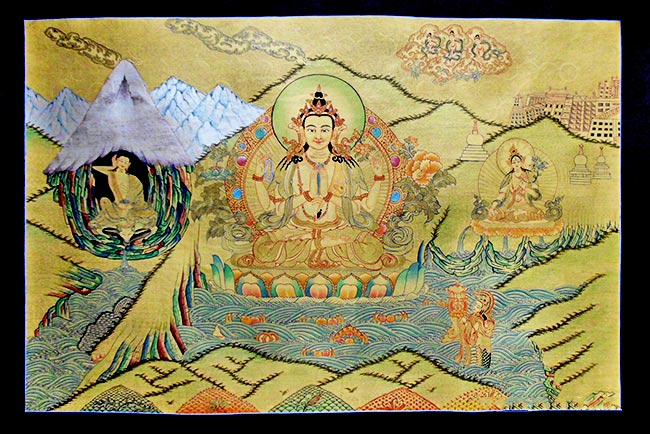
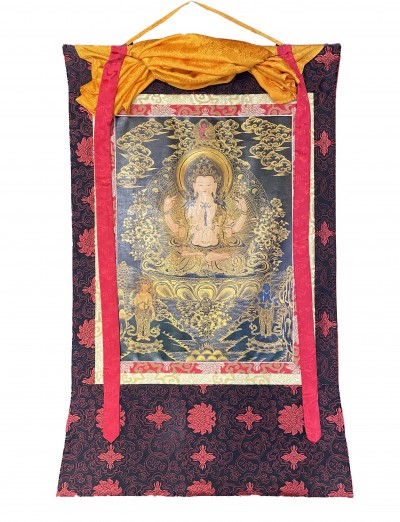
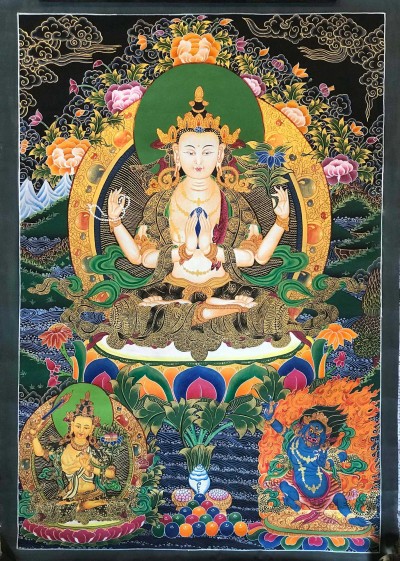
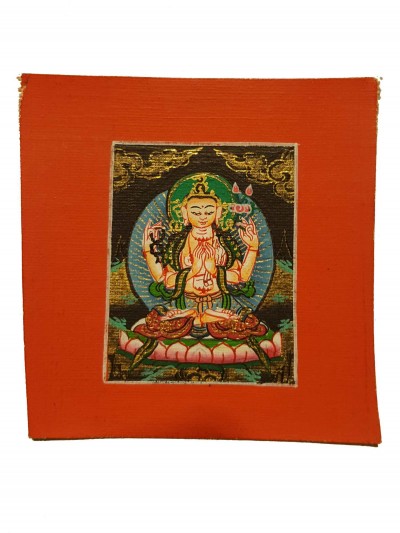
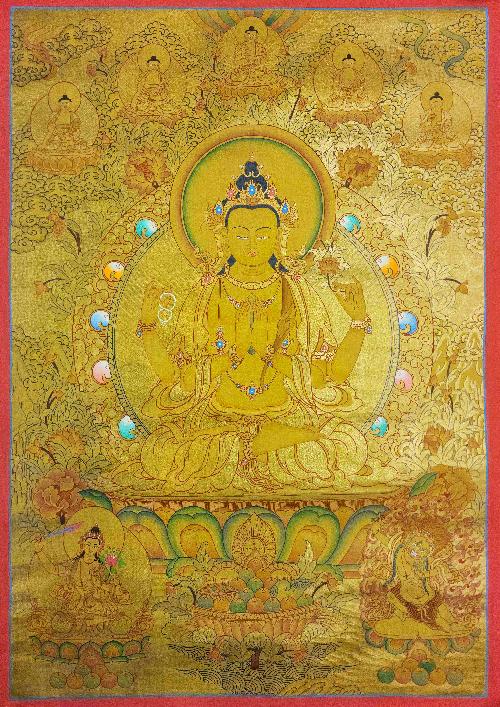
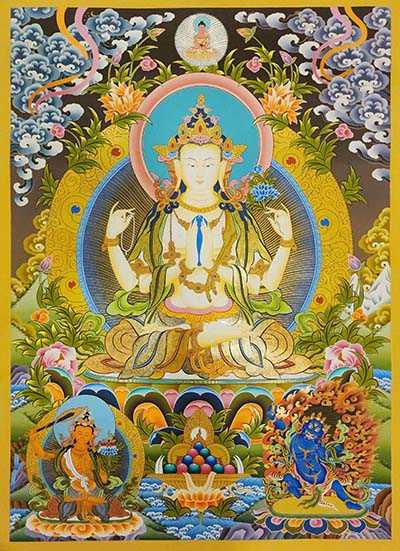
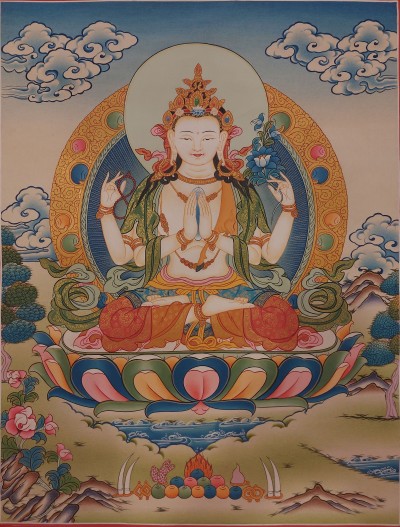
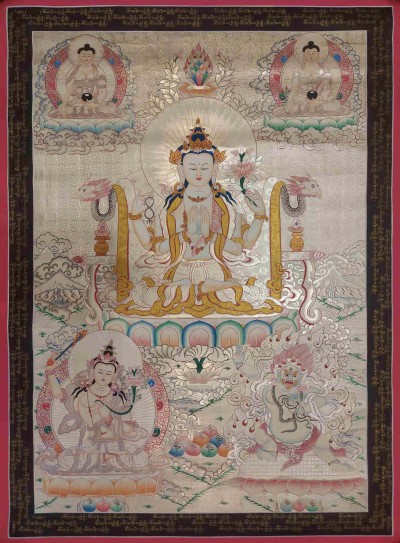
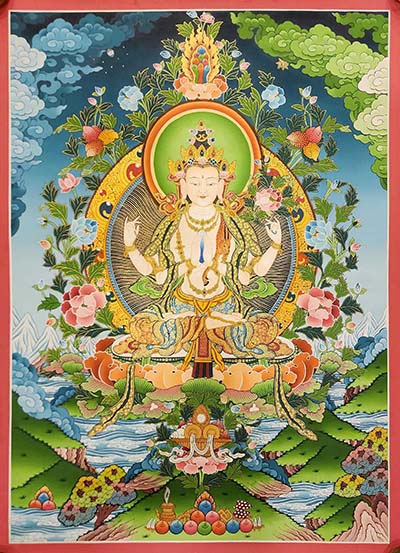
Samaya Tara, popularly known as Green Tara. She is represented in a royal ease posture with her left leg bent her left leg overstepping the main lotus and resting on a blue lotus ready to get up and offer assistance to those in need. She is portrayed with maroon Buddhist robes and jewelry. The earrings represent patience, understanding, and renunciation. The diadem with five jewels represents the transmutation of the five delusions into the Five Buddha Wisdoms. She is shown with a benevolent countenance seated upon a white moon disk which is associated with special restorative nectar associated with the naval chakra center. In Buddhists, the moon symbolizes the wisdom aspect which when coupled with compassion leads to Sakyamuni Buddha's enlightenment. Her right hand is gracefully lowered in Varada mudra, the boon-granting gesture.
Shipping Calculation
The shipping weight for 1 piece of the product is 0.50 kg, and shipping cost is USD31.00.
Note: Shipping Charge for this product will be calculated based on volumetric(dimensional) weight.
Country
Shipping Mode
We normally dispatch orders within 2 to 5 business days. If there are any delays, we will personally inform the buyer about the dispatch date.
We accept Paypal | Credit/Debit Card | Bank Transfer | Money Transfer / Remit Click Here for more Information.
We offer a simple 7-day money-back policy, with the buyer responsible for return shipping. Click Here for more Information.
Green Tara :
Samaya Tara, popularly known as Green Tara. She is represented in a royal ease posture with her left leg bent her left leg overstepping the main lotus and resting on a blue lotus ready to get up and offer assistance to those in need. She is portrayed with maroon Buddhist robes and jewelry. The earrings represent patience, understanding, and renunciation. The diadem with five jewels represents the transmutation of the five delusions into the Five Buddha Wisdoms. She is shown with a benevolent countenance seated upon a white moon disk which is associated with special restorative nectar associated with the naval chakra center. In Buddhists, the moon symbolizes the wisdom aspect which when coupled with compassion leads to Sakyamuni Buddha's enlightenment. Her right hand is gracefully lowered in Varada mudra, the boon-granting gesture.
Vajrapani : Brief Introduction
Vajrapaṇi is one of the earliest bodhisattvas of Mahayana Buddhism. He is the protector and guide of the Buddha, and rose to symbolize the Buddha's power. Vajrapani was used extensively in Buddhist iconography as one of the three protective deities surrounding the Buddha. Each of them symbolizes one of the Buddha's virtues: Manjusri (the manifestation of all the Buddhas' wisdom), Avalokitesvara (the manifestation of all the Buddhas' compassion) and Vajrapani (the manifestation of all the Buddhas' power). Furthermore, Vajrapani is one of the earliest Dharmapalas and one of the rare Buddhist deities to be worshiped in the original Zen Buddhism of the Shaolin Temple, Tibetan Buddhism, and even Pure Land Buddhism (where he is known as Mahasthamaprapta). Manifestations of Vajrapani can also be found in many Buddhist temples in Japan as Dharma protectors called Nio.
Iconography Vajrapani is pictured dancing wildly within a halo of flames, which represent transformation.
He holds a vajra (thunderbolt) in his right hand, which emphasizes the power to cut through the darkness of delusion. Vajrapani looks wrathful, but as a representation of the enlightened mind, he?s completely free from hatred.
Vajrapani?s mantra is simply his name, which means "wielder of the thunderbolt", framed between the mystical syllables Om and Hūm. This mantra helps us to gain access to the irrepressible energy that Vajrapani symbolizes. A familiarity with Vajrapani does, of course, help here, although the sound of the mantra is itself rather energetic.
Matra of Vajrapani
oṃ va jra pā ṇi hūṃ
oṃ vajrapāṇi hūṃ
Read More . . .
Manjushri : Brief Introduction
Manjushree is a Sanskrit word meaning 'gentle glory'. In Sanskrit, "shree" means 'glorious' or 'honorable'. His name signifies one who embodies enlightened wisdom. He confers mastery of the Dharma, wisdom, and eloquence and teaches the path of a bodhisattva in the Mahayana tradition.
Commentary Manjushree is the Bodhisattva who holds the flaming sword [Skt. Khadga] of enlightenment, by his left hand in a warning( Tarjani) hand gesture ( Mudra) in his left hand representing his realization of wisdom to cut through ignorance & wrong view. His right hand depicted in teaching (Jnana Mudra) holds the stem of a Blue Lotus (Utpala) flower upon which rests the Book (Pustaka) of Perfection of Transcendental Wisdom. The blue lotus is a symbol of the victory of the spirit over the senses and signifies the wisdom of knowledge. This represents the lotus that he obtained from the middle of the lake in the Kathmandu Valley out of which grew a lotus bearing a Blue Flame which represents wisdom. Manjushree sits upon a moon disc upon a lotus with an elongated stem arising from a lake. He wears a gold diadem fitted with precious jewels. He wears a silk scarf fastened at the waist and over this, a softly glowing green scarf decorated with golden motifs. His head is silhouetted against a nimbus. The lotus he is sitting on has an elongated stem and arises from a lake representing his recovery of the blue flame of transcendent wisdom and the teaching he originated. The white sash is the attire of the Vajrayana school of Buddhism.
According to legend, Manjushree founded the Nepalese civilization. In ancient times, way before Buddha Shakyamuni the Kathmandu Valley was a vast lake. The Buddha Vipashyin came to Nepal to meditate on the hill above the lake. Wishing to give the rough mountain people an object of worship, Vipashyin threw a lotus seed into the lake. When this lotus bloomed, a blue flame of wisdom light shone from the center of its thousand petals. This light was called the Swayambhunath Dharmadhatu, the Self-Sprung Infinite Field of Light, and the flame of the enlightened mind of the primal Buddha, Vajradhara burned at its center. The light of Vajradhara also emanated in the colors of the rainbow and in each of the five colors appeared one of the Five Buddhas - Vairochana, Akshobhya, Ratnasambhava, Amitabha, and Amoghasiddhi. Then Manjushri went to Nagarkot Peak on the edge of the lake, and after having pondered in Samadhi how best the lake may be drained, with his keen-edged sword of wisdom he cut three Gorges. After the lake had been drained and the Valley bottom made suitable for cultivation Manjushree founded the city of Patan which was originally called Manjupattan. He taught the people many things. Manjushree manifests himself in the form of Yamantaka, known also as Vajrabhairava in order to overcome the lord of Death, Yama.
The Book (Pustaka) represents Transcendent Wisdom which came to be embodied by the Dyani {Pancha} Buddha Families. The book symbolically contains Buddhist teaching that had been lost to mankind & which was revealed to Manjushree. The book is commonly mistaken for the Prajna Paramita which was written by many hands between 100 & 200 CE realizing the Boddhisattva Principle. The book of Manjushree alludes to Wisdom and the emanation of the Five Transcendent Buddha Families. These are Vairochana, Akshobhya, Ratnasambhava, Amitabha & Amoghasiddhi. Wisdom Energy is a power that can extinguish the Five Negative afflictions. Each family heads wisdom and energy to overcome these Five hindrances to enlightenment which are greed, hatred, delusion, jealousy & pride.
Mantra of Manjushree
Om A Ra Pa Ca Na Dhih
Read More . . .
Karma Gadri Art : Karma Gadri Tradition: An introduction
Description inspired from Images of Englitment.
This Custom of Tibetan thangka painting started from the creative ordered trials of the eighth Karmapa, Miky? Dorje (1507-1554). He was one of the most prestigious Karmapas, a great contemplation ace as well as a productive, and student. Energetic about human expression and an imaginative visionary. He generally urged his devotees to master painting and cheered for this action.
The name Karma Gadri (gar-bris) came from the Karmapa settlements
It was set up when Mikyo Dorje and his company needed to travel. He composed an incredible book on craftsmanship named "the Incomparable Sun Workmanship Manual". It was beneficial for future craftsmen.
This thangka painting custom was likewise kept up within a spot called Karshoma, in eastern Tibet. To this end, the custom is known as Karsh?ma.
Since the source is from the eighth Karmapa, it is an unadulterated Tibetan way of painting thangka.
Use of Real Gold
This thangka of Green Tara has real gold painted on its surface along with other paints. This is an ancient process of decorating the thangka in Tibetan Buddhism, Here gold is ground into gold dust, which is then mixed with other undisclosed material to make it paintable on the canvas. this mixture is then mixed with transparent glue and painted on the thangka.
Videos of Applying Gold in the Thangka
Read More . . .
Introduction to Thangka
A thangka, also known as tangka, thanka, or tanka, is a vibrant and intricate Tibetan Buddhist painting that serves as a visual representation of spiritual teachings. Crafted with meticulous detail on cotton or silk appliqu?, thangkas depict a wide range of subjects including Buddhist deities, sacred scenes, mandalas, and narrative stories. These sacred artworks are traditionally kept unframed and rolled up for storage, resembling ancient scrolls. To protect their delicate nature, thangkas are mounted on textile backings and often adorned with a silk cover on the front. Proper preservation in dry environments is crucial to maintain the integrity and longevity of the silk.
These sacred paintings serve as objects of contemplation, inspiration, and instruction, guiding practitioners on their spiritual path. Thangkas provide a visual gateway to the world of Tibetan Buddhism, encapsulating its rich symbolism, iconography, and spiritual concepts. With their vibrant colors, intricate patterns, and skillful craftsmanship, thangkas offer a profound visual medium for deepening one's understanding and connection to the teachings of Buddhism.
Thangkas come in various sizes, ranging from small pieces resembling Western half-length portraits to grand-scale creations spanning several meters in each dimension. While the larger thangkas are intended for temporary display during religious festivals, the majority of these artworks are designed for personal meditation or as educational aids for monastic students. The compositions of thangkas are meticulously crafted, featuring intricate details and often incorporating numerous small figures. A central deity or focal point is typically surrounded by a symmetrical arrangement of other divine beings, symbols, or narrative elements that convey profound spiritual teachings.
How is Thangka made
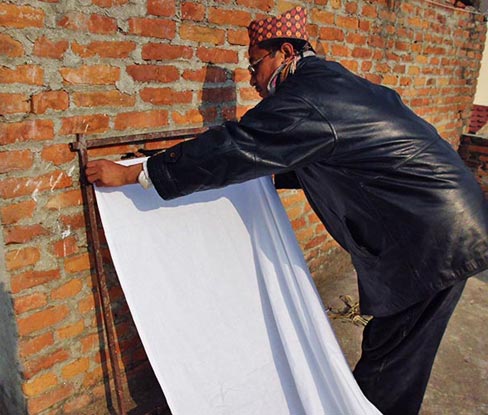
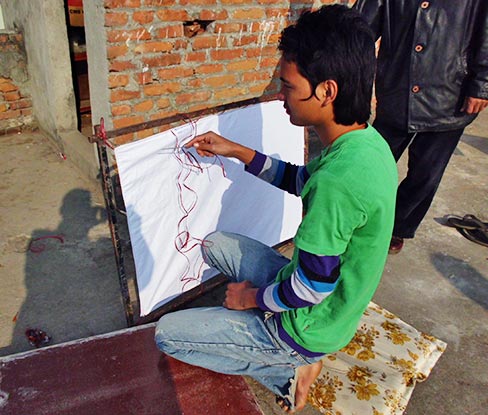
First, the canvas on which the painting is to be executed is laid on a wooden frame to determine the required dimensions. This canvas is an extremely finely woven cotton material, referred to in the Holy Scriptures as "?ura Canvas".
Then the canvas is cut, hemmed and, with the use of sturdy strings, very tightly mounted in the wooden frame. Painting is carried out with the frame in an upright position, without any further rigid support or backing.
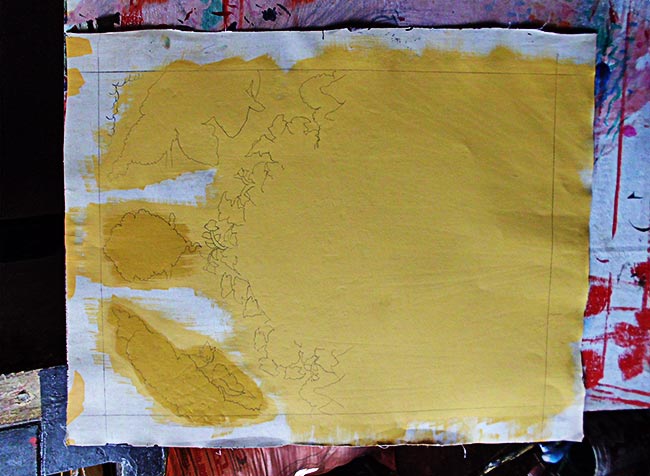
In this studio, our primary artist, who works virtually exclusively for us, applies the undercoat consisting of a mixture of chalk and glue to the canvas by hand. Other Thangka workshops have turned to mainly using industrially pre-primed canvas.
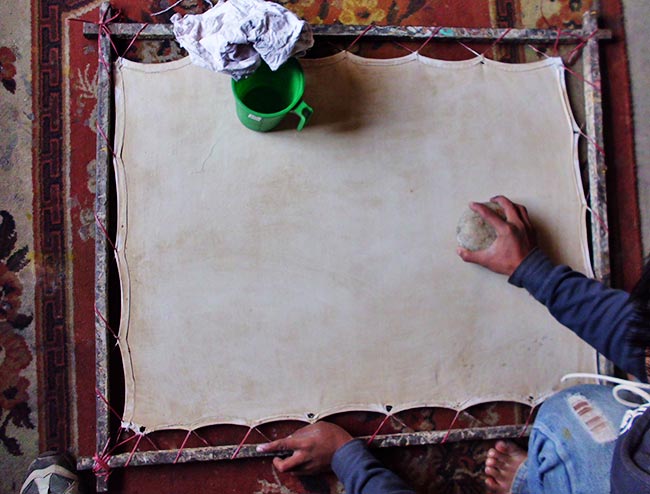
This photo shows how the canvas, after receiving its base coat followed by a second coating of bone glue, is polished and smoothed by hand with a stone to attain a perfectly smooth, featureless painting surface. Through this process the canvas becomes quite rigid, thereby providing perfect conditions to evoke very finest artistic detail and over-all superior painting quality.
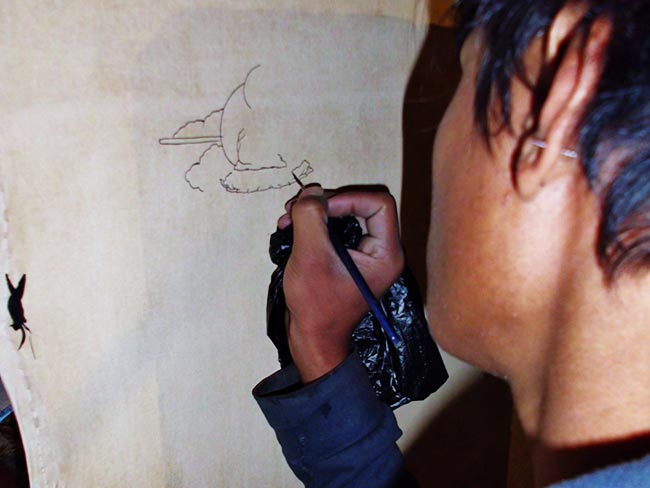
Using a different Thangka, we see how, after mounting, the complete basic pattern of the respective theme is applied to the canvas.
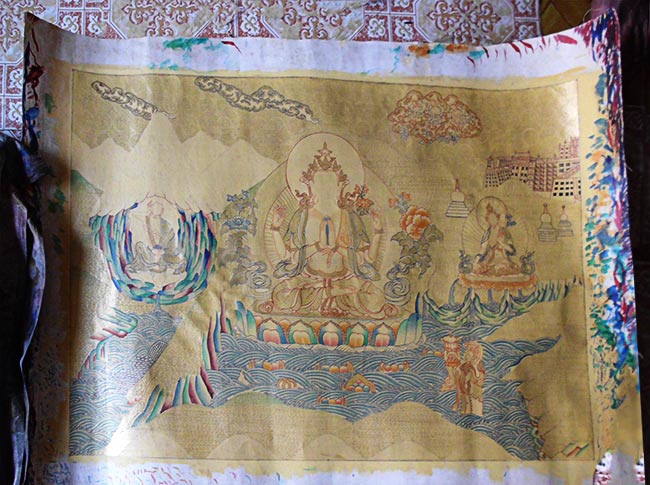
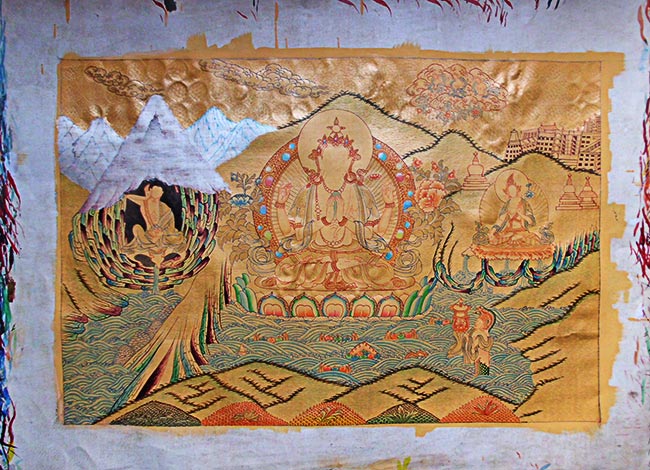
The following picture shows the steps in creating a gold-based Thangka, such as our No PH 9, the "Holy Mount Kailash". To achieve more intensive colour, yet another prime coat, in ochre, is applied, followed by a coat of pure gold. The so-called Thangka painting gold is traditionally produced by members of the Newar people in Nepal. 24-karat gold is ground to finest powder and mixed with bone glue and water in proportions suitable for direct use in painting. Thus, the Thangka gold is not gold leaf at all! Silver can be processed and used in the same way: Mount Kailash and the surrounding peaks in our completed Thangka were not painted with white paint, rather with precious silver.
Here, the nearly completed piece has been removed from the wooden frame. Now only the very finest finishing touches remain to be added, such as compacting the gold and giving Mount Kailash its silver mantle.
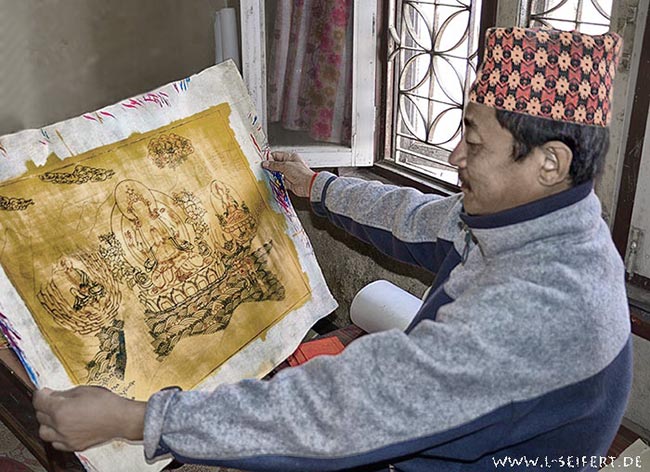
K. Lama regarded his already half-finished thangka proudly
The Mount Kailash Thangka, including the black margin (which can also facilitate the fastening of a traditional brocade frame), is now complete. Only the background gold must be compacted in the places where it is later intended to exhibit a sheen.
Here we see an old ballpoint pen casing into which a specially cut agate has been fitted. The back of this semi-precious stone is slightly concave and can be used to compact gold over extensive areas of the Thangka, while the blunt point is used to lineally compact gold, thus creating a shiny effect.
In this way, through partial compaction of the gold or refraining from compaction, nearly three-dimensional effects can be achieved. The glorious sheen of gold artistically treated in this way richly rewards the beholder or meditator with a Thangka possessed of an extraordinarily aesthetic aura.
Thangka Making Video
Read More . . .
Iconography :
Green Tara's special lotus is the blue lotus or 'night lotus' which she bears in both hands. The word utpala means to 'burst open'. Her left-hand holds a stem with an open blooming flower and an unopened bud. The bent lower part of the stem represents the root. The open blossom represents the present and also the present Buddha; the bud represents the future and also Buddhas yet to be born. The future here also refers to a safe journey's end and future well-being. Her right-hand wisdom hand is in the gesture of giving refuge. The third finger touches the thumb to create a circle representing the union of wisdom and compassion, and the three extended fingers symbolize the Three Jewels of Buddhism a. The Buddha State b. The Body of Teachings. The Principles of the Universe The same hand holds the stem of a blue lotus representing her willingness to assist. The closed blossom in her right hand represents the past and also the Buddhas of the past. Green Tara is shown in a place of paradise called Khadiravani where she Tara dwells. Khadiravani is described as a great mountain kingdom with many trees, flowers, and animals (not shown). 3 rainbow tails emanate from her outer aureole. The crescent moon and sun symbolize the union of male and female ubiquitous in Tantric art.
<br/><br/>
The seventy-two golden lines represent psychic energy channels emanating from her body and her central psychic channel running up her spinal column. Each one signifies a thousand as there are traditionally seventy-two thousand channels. The gold lines alternate between wiggly and straight to represent the two main psychic channels running up the central channel that entwine to create the interlocking 'snaking' caduceus to which the energy channels are connected. The trees in the foreground are the Ashoka Tree. The word Ashoka means 'without sorrow' and is the tree linked to the Vedic God of love and sexual union Kamadeva. Apparently, the tree blossoms when a virtuous lady touches it.
Commentary :
The word Tara means the one who saves. The word Tara is derived from the root tri meaning to cross and in context is taken to mean the one who helps people to cross the Ocean of Existence and Suffering. Green Tara is also called 'dark' Tara or more directly Shyama Tara. Green Tara is associated with the Amoghasiddhi who is also green and the north-facing Meditation who is head of the action family. Her willingness to help others is shown by her body posture with one foot ready so that she can rise to offer assistance. Like WhiteTara, she was born of the tears of compassion of the Bodhisattva Avalokiteshvara, resulting from the extreme state of sadness he experienced when observing the continuing ceaseless suffering which he sought to end.
At Handicraft Seller, we believe in providing a seamless and user-friendly experience to our valued customers. While our website is not an online shopping platform, we have incorporated a shopping cart system to simplify the process of sending us your inquiries. Please follow the steps below to place your order:
Step 1: Browsing the Selection Explore our website to discover a delightful array of authentic Nepali handicraft products. Click on the products you are interested in to view detailed descriptions and images.
Step 2: Adding Items to Your Inquiry Cart To express your interest in a particular product, click the "Add to Inquiry Cart" button associated with that item. The shopping cart will accumulate your selected products, providing a convenient way to organize your choices.
Step 3: Reviewing Your Inquiry Cart Once you have finished selecting the items you wish to inquire about, review your "Inquiry Cart" to ensure accuracy.
Step 4: Sending Your Inquiries Proceed to submit your inquiries by clicking the "Submit Inquiry" button. A form will prompt you to provide your contact details, the selected products, and any specific queries you may have.
Step 5: Communicating through Email As we do not have an automated payment system, we will conduct the business process through email. Our team will review your inquiries and respond via email, offering further assistance and guidance.
Step 6: Clarifying Details and Finalizing Your Order Engage in direct communication with our team to clarify any additional information or customization requests. Once you are satisfied with the details, we will provide you with payment instructions and confirm the order.
Step 7: Completing the Transaction Make the payment through the designated method as provided in the email. After receiving the payment, we will process your order and prepare it for shipment.
Step 8: Shipping and Delivery We offer worldwide shipping for all our products. Once your order is dispatched, we will provide you with shipping details and tracking information.
Step 9: Receiving and Enjoying Your Handicrafts Wait for your exquisite handicrafts to arrive at your doorstep. Unpack and revel in the beauty and craftsmanship of your chosen Nepali treasures.
Contacting Us If you encounter any complications while submitting your inquiries or need further assistance, please feel free to contact us. Preferably, reach out to us through WhatsApp or email for prompt responses and support.
We hope this straightforward ordering process ensures a delightful and satisfying experience with Handicraft Seller. Thank you for choosing us to connect you with the rich heritage of Nepali handicrafts.
Return Policy
We have a 7 days money back policy but buyer have to pay the return shipping charges.
Shipping
Shipping cost is calculated, based on the shipping weight of the products ordered. THe normal Shipping cost is US$25 for upto 0.5 kgs weight
We ship Worldwide, Except Russia and India.
The deliver duration varies for international Shipping location. We normally dispatch the product in 2 -3 business days. Else Buyer will be infromed Personally about the shipping.
This is not a direct shopping website. So no payments are needed for placing an order. Please feel free to send us an order for the product you are interested in, mentioning the approximate quantity. Based on which we will send you a wholesale price quotation.
![Buddhist [karma Gadri Art], Handmade Thangka Of Green Tara, [real Gold, Hand Painted] Supported By Manjushri And Vajrapani](https://www.handmadeexpo.com/pics/product/26351.jpg)

![Buddhist [karma Gadri Art], Handmade Thangka Of Green Tara, [real Gold, Hand Painted] Supported By Manjushri And Vajrapani](https://www.handmadeexpo.com/pics/product/thumb/26351.jpg)
![Buddhist [karma Gadri Art], Handmade Thangka Of Green Tara, [real Gold, Hand Painted] Supported By Manjushri And Vajrapani](https://www.handmadeexpo.com/pics/product/thumb/26351_0.jpg)
![Buddhist [karma Gadri Art], Handmade Thangka Of Green Tara, [real Gold, Hand Painted] Supported By Manjushri And Vajrapani](https://www.handmadeexpo.com/pics/product/thumb/26351_1.jpg)
![Buddhist [karma Gadri Art], Handmade Thangka Of Green Tara, [real Gold, Hand Painted] Supported By Manjushri And Vajrapani](https://www.handmadeexpo.com/pics/product/thumb/26351_2.jpg)
![Buddhist [karma Gadri Art], Handmade Thangka Of Green Tara, [real Gold, Hand Painted] Supported By Manjushri And Vajrapani](https://www.handmadeexpo.com/pics/product/thumb/26351_3.jpg)
![Buddhist [karma Gadri Art], Handmade Thangka Of Green Tara, [real Gold, Hand Painted] Supported By Manjushri And Vajrapani](https://www.handmadeexpo.com/pics/product/thumb/26351_4.jpg)
![Buddhist [karma Gadri Art], Handmade Thangka Of Green Tara, [real Gold, Hand Painted] Supported By Manjushri And Vajrapani](https://www.handmadeexpo.com/pics/product/thumb/26351_5.jpg)