Product Categories
Metal Statues
Thangka & Wall Decor
Sound & Spirituality
Buddhist Ritual Object
![Ganesh With Ashtamangala [hand Carved], Conch Shell](https://www.handmadeexpo.com/pics/product/13166.jpg)

![Ganesh With Ashtamangala [hand Carved], Conch Shell](https://www.handmadeexpo.com/pics/product/thumb/13166.jpg)
![Ganesh With Ashtamangala [hand Carved], Conch Shell](https://www.handmadeexpo.com/pics/product/thumb/13166_0.jpg)
![Ganesh With Ashtamangala [hand Carved], Conch Shell](https://www.handmadeexpo.com/pics/product/thumb/13166_1.jpg)
Ganesh with Ashtamangala Hand Carved, Conch Shell
Sankha
Ganesha is one of the deities best-known and most widely worshiped in the Hindu pantheon. His image is found throughout India and Nepal. Hindu sects worship him regardless of affiliations. Devotion to Ganesha is widely diffused and extends to Jains, Buddhists, and beyond India.
Although he is known for many other attributes, Ganesha's elephant head makes him particularly easy to identify. Ganesha is widely revered as the Remover of Obstacles and more generally as Lord of Beginnings and Lord of Obstacles, patron of arts and sciences, and the deva of intellect and wisdom. He is honored at the beginning of rituals and ceremonies and invoked as Patron of Letters during writing sessions. Several texts relate mythological anecdotes associated with his birth and exploits and explain his distinct iconography. Read More . . .
The Ashtamangala is a sacred suite of Eight Auspicious Signs endemic to a number of religions such as Hinduism, Jainism, and Buddhism. The symbols or "symbolic attributes" are yidam and teaching tools. Not only do these attributes point to qualities of enlightened mindstream, but they are the investiture that ornaments these enlightened "qualities". Many cultural enumerations and variations of the Ashtamangala are extant. Read More . . .


In addition to Buddha's throat, the conch also appears as an auspicious mark on the soles, palms, limbs, breast or forehead of a divinely endowed being.
The fourfold caste division is also applied as follows:
The smooth white conch represents the Brahmin caste (priests)
The red conch, the kshatriyas (warriors)
The yellow conch, the vaishyas (merchants)
The grey conch, the shudras (labourers)
Additionally, there is a fundamental classification of conch shells occurring in nature: those that turn to the left and those which turn to the right. Shells which spiral to the right in a clockwise direction are a rarity and are considered especially sacred. The right-spiralling movement of such a conch is believed to echo the celestial motion of the sun, moon, planets and stars across the heavens. The hair whorls on Buddha's head spiral to the right, as do his fine body hairs, the long curl between his eyebrows (urna), and also the conch-like swirl of his navel.
Arjuna's (hero of the Mahabharata) mighty conch was known as Devadatta, whose triumphant blast brought terror to the enemy. As a proclaiming battle horn, the conch is akin to the bugle. It is an emblem of power, authority and sovereignty whose blast is believed to banish evil spirits, avert natural disasters, and scare away poisonous creatures.
Today, in its greatly tamed avatar, the conch is used in Tibetan Buddhism to call together religious assemblies. During the actual practise of rituals, it is used both as a musical instrument and as a container for holy water.
Ancient Indian belief classifies the conch into male and female varieties. The thicker-shelled bulbous one is thought to be the male (purusha), and the thin-shelled slender conch to be the female (shankhini).
Buddhist monk blowing conch shell at Mindrolling Monastery
You may also want to read the related articles :
At Handicraft Seller, we believe in providing a seamless and user-friendly experience to our valued customers. While our website is not an online shopping platform, we have incorporated a shopping cart system to simplify the process of sending us your inquiries. Please follow the steps below to place your order:
Step 1: Browsing the Selection
Explore our website to discover a delightful array of authentic Nepali handicraft products.
Click on the products you are interested in to view detailed descriptions and images.
Step 2: Adding Items to Your Inquiry Cart
To express your interest in a particular product, click the "Add to Inquiry Cart" button associated with that item.
The shopping cart will accumulate your selected products, providing a convenient way to organize your choices.
Step 3: Reviewing Your Inquiry Cart
Once you have finished selecting the items you wish to inquire about, review your "Inquiry Cart" to ensure accuracy.
Step 4: Sending Your Inquiries
Proceed to submit your inquiries by clicking the "Submit Inquiry" button.
A form will prompt you to provide your contact details, the selected products, and any specific queries you may have.
Step 5: Communicating through Email
As we do not have an automated payment system, we will conduct the business process through email.
Our team will review your inquiries and respond via email, offering further assistance and guidance.
Step 6: Clarifying Details and Finalizing Your Order
Engage in direct communication with our team to clarify any additional information or customization requests.
Once you are satisfied with the details, we will provide you with payment instructions and confirm the order.
Step 7: Completing the Transaction
Make the payment through the designated method as provided in the email.
After receiving the payment, we will process your order and prepare it for shipment.
Step 8: Shipping and Delivery
We offer worldwide shipping for all our products.
Once your order is dispatched, we will provide you with shipping details and tracking information.
Step 9: Receiving and Enjoying Your Handicrafts
Wait for your exquisite handicrafts to arrive at your doorstep.
Unpack and revel in the beauty and craftsmanship of your chosen Nepali treasures.
Contacting Us
If you encounter any complications while submitting your inquiries or need further assistance, please feel free to contact us.
Preferably, reach out to us through WhatsApp or email for prompt responses and support.
We hope this straightforward ordering process ensures a delightful and satisfying experience with Handicraft Seller. Thank you for choosing us to connect you with the rich heritage of Nepali handicrafts.
Return Policy
We have a 7 days money back policy but buyer have to pay the return shipping charges.
Shipping
- Shipping cost is calculated, based on the shipping weight of the products ordered. THe normal Shipping cost is US$25 for upto 0.5 kgs weight
- We ship Worldwide, Except Russia and India.
- The deliver duration varies for international Shipping location. We normally dispatch the product in 2 -3 business days. Else Buyer will be infromed Personally about the shipping.
Related Products
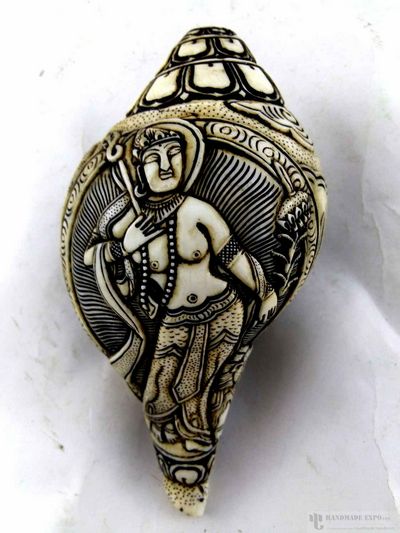
17cm Padmapani Lokeshvara Hand Carved, Conch Shell
Weight : 0.6kg | [13167]
US$135
US$108
You Save
US$27
(20%)
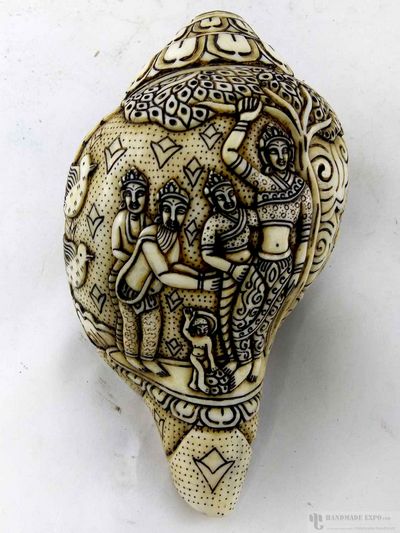
17cm Queen Mayadevi Buddha Birth, Hand Carved, Conch Shell
Weight : 0.6kg | [13163]
US$150
US$120
You Save
US$30
(20%)
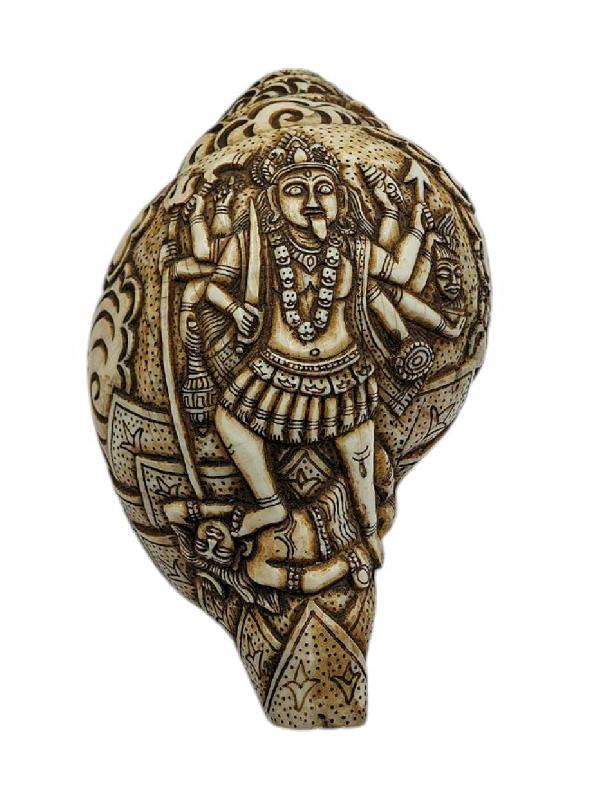
9cm Conch Shell With Kali Hand Carved
Weight : 0.71kg | [33821]
US$90
US$72
You Save
US$18
(20%)
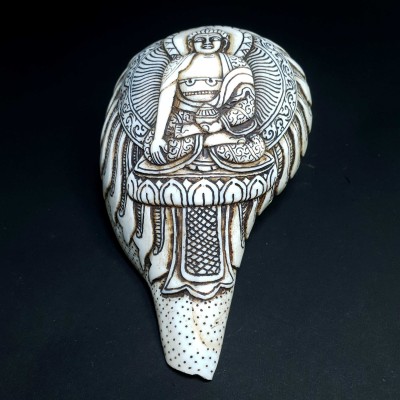
20cm Tibetan Conch Shell With Shakyamuni Buddha Hand Carved
Weight : 0.8kg | [21780]
US$110
US$88
You Save
US$22
(20%)
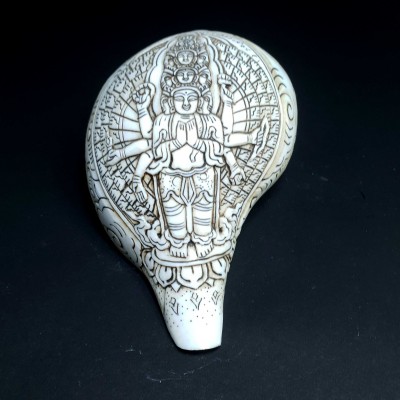
20cm Tibetan Conch Shell With Sahasrabhuja Avalokitesvara Hand Carved
Weight : 0.8kg | [21782]
US$110
US$88
You Save
US$22
(20%)
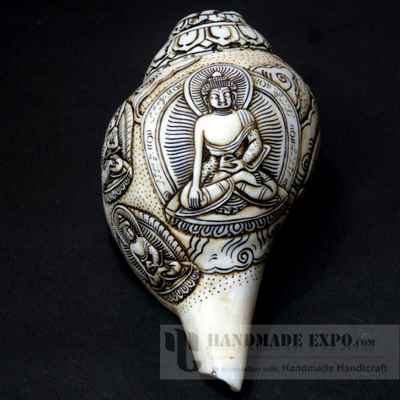
22cm Dhyani Buddha Carved Conch Shell
Weight : 2kg | [10842]
US$150
US$120
You Save
US$30
(20%)
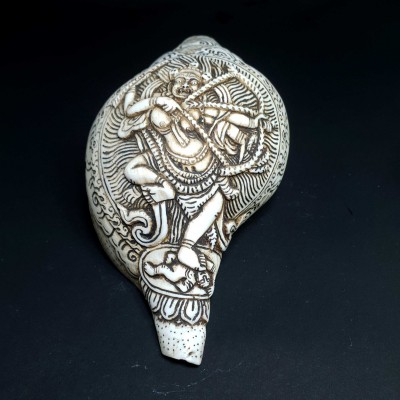
20cm Tibetan Conch Shell With Kurukulla Hand Carved, Rigjeyma, Pema Khandro, Wangyi Lhamo, Red Tara
Weight : 0.8kg | [21783]
US$110
US$88
You Save
US$22
(20%)
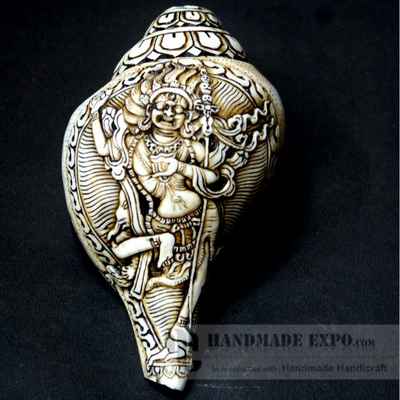
22cm Niratama Jogini Carved Conch Shell
Weight : 2kg | [10844]
US$180
US$144
You Save
US$36
(20%)