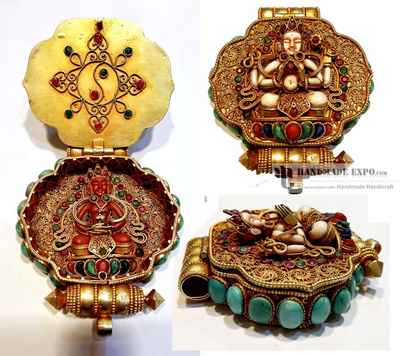
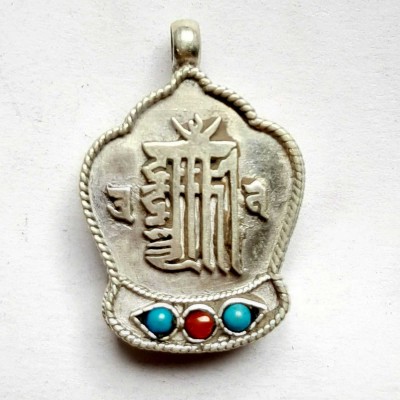
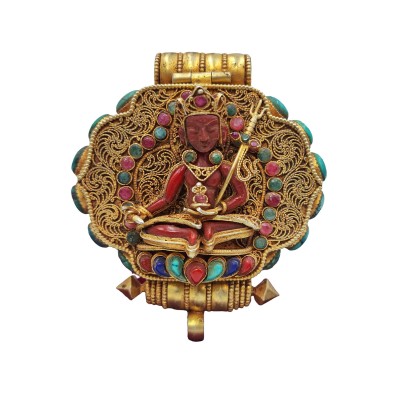
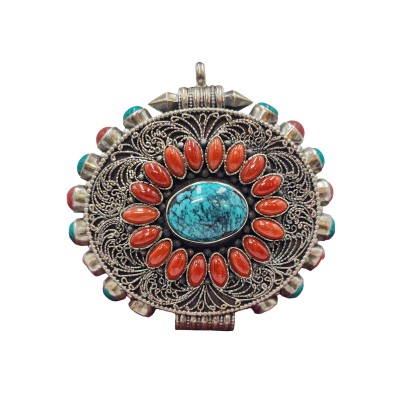
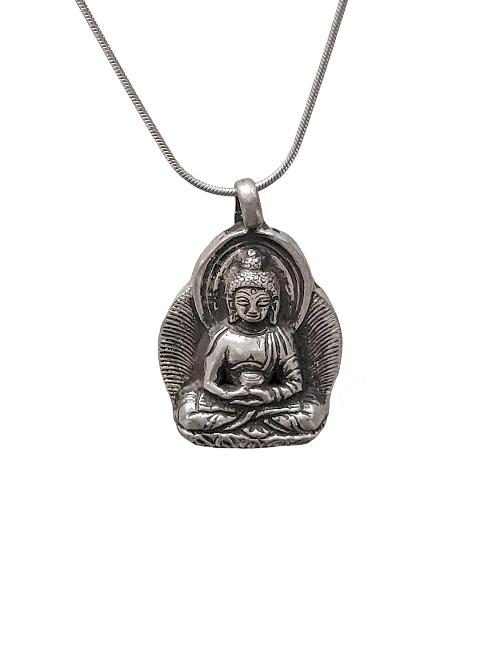
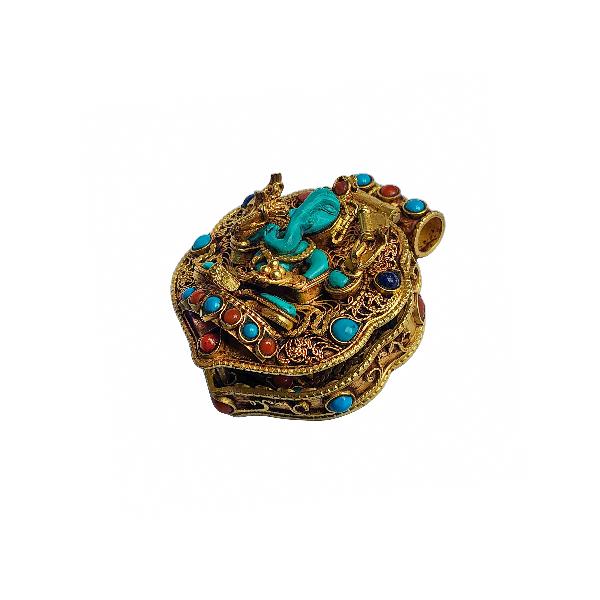
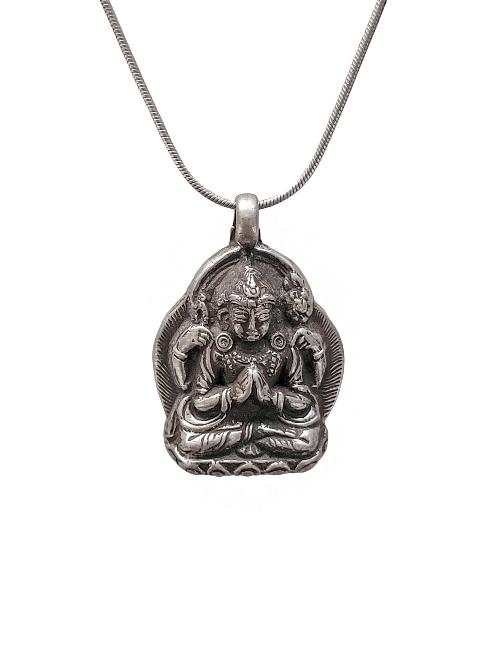
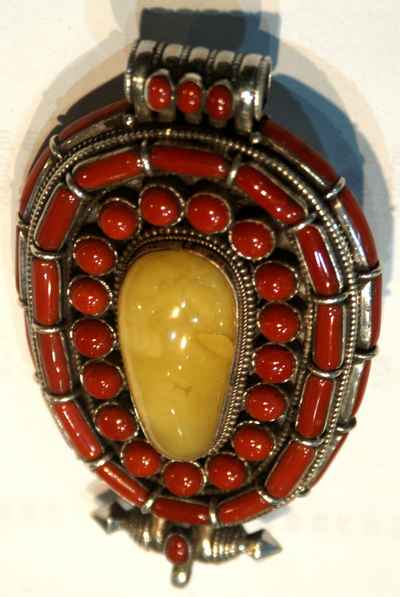
Ghau is a portable shrine in which an image of the owner's personal deity (Ishta Devata) is kept wrapped in silk cloth. Most Tibetans used Ghau at home and during traveling. At home, it is kept on alter but when traveling it is fastened at the cross belt. Generally, Ghau has trefoil shapes to and a window in the middle through which one can see the personal deity. Ghau is made of two parts which fit together to form a box. The back is usually left plain and the front is richly decorated.
Mandala : Brief Introduction On Mandala
Mandala Thangka painting is a revered form of sacred art in Buddhism, characterized by intricate and vibrant depictions on cotton or silk. These paintings often feature a central deity or Buddha figure surrounded by meticulously crafted symmetrical patterns, geometric designs, and symbolic elements. Mandala Thangkas serve as visual aids for meditation and spiritual growth, guiding practitioners towards inner peace, harmony, and enlightenment. Through their precise brushwork and rich symbolism, these artworks invite viewers to contemplate the profound spiritual journey within themselves, fostering mindfulness, concentration, and a deeper connection with the universal truths of Buddhism.
These mandalas, concentric diagrams, have spiritual and ritual significance in both Buddhism and Hinduism. The term is of Hindu origin and appears in the Rig Veda as the name of the sections of the work, but is also used in other Indian religions, particularly Buddhism. In the Tibetan branch of Vajrayana Buddhism, mandalas have been developed into sandpainting. They are also a key part of anuttarayoga tantra meditation practices.
Hinduism and buddhism Buddhism
Tibetan for mandala in Vajrayana Buddhism usually depicts a landscape of the "Buddha-land", or the enlightened vision of a Buddha, which inevitably represents the nature of experience and the intricacies of both the enlightened and confused mind, or "a microcosm representing various divine powers at work in the universe." Such mandalas consist of an outer circular mandala and an inner square (or sometimes circular) mandala with an ornately decorated mandala "palace" placed at the center. Any part of the inner mandala can be occupied by Buddhist glyphs and symbols, as well as by images of its associated deities, which "symbolise different stages in the process of the realisation of the truth."
Kvarne (1975: p. 164) in his extended discussion of sahaja, discusses the relationship of sadhana interiority and exteriority in relation to mandala thus:
"...external ritual and internal sadhana form an indistinguishable whole, and this unity finds its most pregnant expression in the form of the mandala, the sacred enclosure consisting of concentric squares and circles drawn on the ground and representing that adamant plane of being on which the aspirant to Buddha hood wishes to establish himself. The unfolding of the tantric ritual depends on the mandala; and where a material mandala is not employed, the adept proceeds to construct one mentally in the course of his meditation."
Mandalas are commonly used by tantric Buddhists as an aid to meditation. More specifically, a Buddhist mandala is envisaged as a "sacred space," a "Pure Buddha Realm," and also as an abode of fully realised beings or deities. While on the one hand, the mandala is regarded as a place separated and protected from the ever-changing and impure outer world of samsara, and is thus seen as a "Buddhafield" or a place of Nirvana and peace, the view of Vajrayana Buddhism sees the greatest protection from samsara being the power to see samsaric confusion as the "shadow" of purity (which then points towards it). By visualizing "pure lands," one learns to understand experience itself as pure, and as the abode of enlightenment. The protection that we need, in this view, is from our own minds, as much as from external sources of confusion. In many tantric mandalas, this aspect of separation and protection from the outer samsaric world is depicted by "the four outer circles: the purifying fire of wisdom, the vajra circle, the circle with the eight tombs, the lotus circle." The ring of vajras forms a connected fence-like arrangement running around the perimeter of the outer mandala circle.
The mandala is also "a support for the meditating person," something to be repeatedly contemplated to the point of saturation, such that the image of the mandala becomes fully internalised in even the minutest detail and can then be summoned and contemplated at will as a clear and vivid visualized image. With every mandala comes what Tucci calls "its associated liturgy...contained in texts known as tantras," instructing practitioners on how the mandala should be drawn, built and visualised, and indicating the mantras to be recited during its ritual use.
As a meditation on impermanence (a central teaching of Buddhism), after days or weeks of creating the intricate pattern of a sand mandala, the sand is brushed together and placed in a body of running water to spread the blessings of the mandala.
A mandala can also represent the entire universe, which is traditionally depicted with Mount Meru as the axis mundi in the center, surrounded by the continents. A "mandala offering" in Tibetan Buddhism is a symbolic offering of the entire universe. Every intricate detail of these mandalas is fixed in the tradition and has specific symbolic meanings, often on more than one level.
The mandala can be shown to represent in visual form the core essence of the Vajrayana teachings. In the mandala, the outer circle of fire usually symbolises wisdom. The ring of 8 charnel grounds represents the Buddhist exhortation to always be mindful of death, and the impermanence with which samsara is suffused: "such locations were utilized in order to confront and to realize the transient nature of life." Described elsewhere: "within a flaming rainbow nimbus and encircled by a black ring of dorjes, the major outer ring depicts the eight great charnel grounds, to emphasize the dangerous nature of human life." Inside these rings lie the walls of the mandala palace itself, specifically a place populated by deities and Buddhas.
One well-known type of mandala, in Japan is the mandala of the "Five Buddhas", archetypal Buddha forms embodying various aspects of enlightenment. Such Buddhas are depicted depending on the school of Buddhism, and even the specific purpose of the mandala. A common mandala of this type is that of the Five Wisdom Buddhas (a.k.a. Five Jinas), the Buddhas Vairocana, Aksobhya, Ratnasambhava, Amitabha and Amoghasiddhi. When paired with another mandala depicting the Five Wisdom Kings, this forms the Mandala of the Two Realms.
Hindisum
A yantra is a two- or three-dimensional geometric composition used in sadhanas, or meditative rituals. It is thought to be the abode of the deity. Each yantra is unique and calls the deity into the presence of the
practitioner through the elaborate symbolic geometric designs. According to one scholar, "Yantras function as revelatory symbols of cosmic truths and as instructional charts of the spiritual aspect of human experience"
Many situate yantras as central focus points for Hindu tantric practice.Yantras are not representations, but are lived, experiential, nondual realities. As Khanna describes:
Despite its cosmic meanings a yantra is a reality lived. Because of the relationship that exists in the Tantras between the outer world (the macrocosm) and man's inner world (the microcosm), every symbol in a yantra is ambivalently resonant in inner-outer synthesis, and is associated with the subtle body and aspects of human consciousness
Read More . . .
Finishing: Stone Setting
The Ghau is adorned with an exquisite array of semi-precious stones, including turquoise, coral, and lapis lazuli. These stones are carefully selected and meticulously placed on the Ghau's surface, adding a touch of opulence and enhancing its overall beauty. Each stone is thoughtfully positioned using a high-quality adhesive, ensuring secure and long-lasting attachment. The vibrant colors and unique patterns of the stones create a captivating contrast against the backdrop of the Ghau, elevating its visual appeal and making it truly eye-catching.
Beyond their decorative purpose, these semi-precious stones carry symbolic significance in various cultures and traditions. Turquoise is often associated with protection and healing, coral represents vitality and passion, while lapis lazuli symbolizes wisdom and truth. The inclusion of these stones not only adds to the aesthetic allure of the Ghau but also imbues it with deeper meaning and cultural symbolism.
The intricate placement of these semi-precious stones showcases the meticulous craftsmanship and attention to detail that goes into the creation of the Ghau. It is a testament to the skill and artistic vision of the artisans who delicately adorn the statue, resulting in a truly remarkable and captivating piece of art.
Read More . . .
Seku Design : What is Seku Desing
Seku is a traditional Newari craftsmanship technique that involves the use of thin metal wire, typically copper or silver, to create intricate patterns on various objects. The word "Seku" is derived from the Newari language, and is commonly used to refer to this type of craftsmanship. This technique is a prominent aspect of Newari art and has been passed down through generations of artisans.
The process of creating Seku designs involves carefully shaping and molding the metal wire into various patterns. This can include simple geometric shapes or more complex, detailed designs. The wire is then carefully placed onto the surface of the object, where it is secured in place. The final result is a beautiful and intricate design that showcases the skill and precision of the artisan.
Seku craftsmanship can be found on a variety of different objects, including traditional Newari jewelry, home decor, and even architectural elements. The technique is often used to add decorative touches to objects that are already rich in cultural significance, such as statues of deities and other religious artifacts. The intricate and detailed nature of the craftsmanship makes it highly valued and respected within the Newari community, and it continues to be an important aspect of their cultural heritage.
Read More . . .
About Elector Gold Plating
The Ghau has been crafted using the ceramic mold casting process, a modern approach that provides an alternative to traditional methods such as the lost-wax system or rubber molding. Also referred to as ceramic molding, this technique involves the creation of a ceramic mold to cast the statue. The process begins by making a precise and detailed wax model of the desired sculpture. The wax model is then coated with layers of ceramic material, creating a sturdy mold. Once the mold is complete, it is fired in a kiln, causing the wax to melt and escape, leaving behind a cavity that perfectly replicates the original sculpture. Molten metal is then poured into the mold, allowing it to fill the cavity and take on the desired form. Once cooled and solidified, the ceramic mold is carefully broken away, revealing the final metal statue.
The process begins with the thorough cleaning and preparation of the object to be plated. A layer of silver plating is first applied to create a base. Subsequently, the object is submerged in a solution containing gold ions, while an electric current is passed through the solution. The gold ions are attracted to the surface of the object, forming a layer that can be polished to achieve a smooth and radiant finish.
The Full Electro Gold plated finishing offers several advantages, including affordability and high-quality results. In Nepal's handicraft industry, this method of gold plating is gaining popularity due to its ability to produce exquisite and long-lasting handicraft items. Skilled craftsmen employ their expertise to ensure that the gold plating is of the utmost quality, resulting in beautiful and durable Ghau products.
By choosing the Full Electro Gold plated finishing, you can enjoy the luxurious and captivating allure of gold, enhancing the aesthetic appeal of the Ghau product while ensuring its longevity and enduring beauty.
Read More . . .
You may also want to read the related articles :
At Handicraft Seller, we believe in providing a seamless and user-friendly experience to our valued customers. While our website is not an online shopping platform, we have incorporated a shopping cart system to simplify the process of sending us your inquiries. Please follow the steps below to place your order:
Step 1: Browsing the Selection Explore our website to discover a delightful array of authentic Nepali handicraft products. Click on the products you are interested in to view detailed descriptions and images.
Step 2: Adding Items to Your Inquiry Cart To express your interest in a particular product, click the "Add to Inquiry Cart" button associated with that item. The shopping cart will accumulate your selected products, providing a convenient way to organize your choices.
Step 3: Reviewing Your Inquiry Cart Once you have finished selecting the items you wish to inquire about, review your "Inquiry Cart" to ensure accuracy.
Step 4: Sending Your Inquiries Proceed to submit your inquiries by clicking the "Submit Inquiry" button. A form will prompt you to provide your contact details, the selected products, and any specific queries you may have.
Step 5: Communicating through Email As we do not have an automated payment system, we will conduct the business process through email. Our team will review your inquiries and respond via email, offering further assistance and guidance.
Step 6: Clarifying Details and Finalizing Your Order Engage in direct communication with our team to clarify any additional information or customization requests. Once you are satisfied with the details, we will provide you with payment instructions and confirm the order.
Step 7: Completing the Transaction Make the payment through the designated method as provided in the email. After receiving the payment, we will process your order and prepare it for shipment.
Step 8: Shipping and Delivery We offer worldwide shipping for all our products. Once your order is dispatched, we will provide you with shipping details and tracking information.
Step 9: Receiving and Enjoying Your Handicrafts Wait for your exquisite handicrafts to arrive at your doorstep. Unpack and revel in the beauty and craftsmanship of your chosen Nepali treasures.
Contacting Us If you encounter any complications while submitting your inquiries or need further assistance, please feel free to contact us. Preferably, reach out to us through WhatsApp or email for prompt responses and support.
We hope this straightforward ordering process ensures a delightful and satisfying experience with Handicraft Seller. Thank you for choosing us to connect you with the rich heritage of Nepali handicrafts.
Return Policy
We have a 7 days money back policy but buyer have to pay the return shipping charges.
Shipping
Shipping cost is calculated, based on the shipping weight of the products ordered. THe normal Shipping cost is US$25 for upto 0.5 kgs weight
We ship Worldwide, Except Russia and India.
The deliver duration varies for international Shipping location. We normally dispatch the product in 2 -3 business days. Else Buyer will be infromed Personally about the shipping.
This is not a direct shopping website. So no payments are needed for placing an order. Please feel free to send us an order for the product you are interested in, mentioning the approximate quantity. Based on which we will send you a wholesale price quotation.
Related Products
10cm Chenrezig Aparimita Ghau, Silver Ghau, Gold Plated, And Real Stones