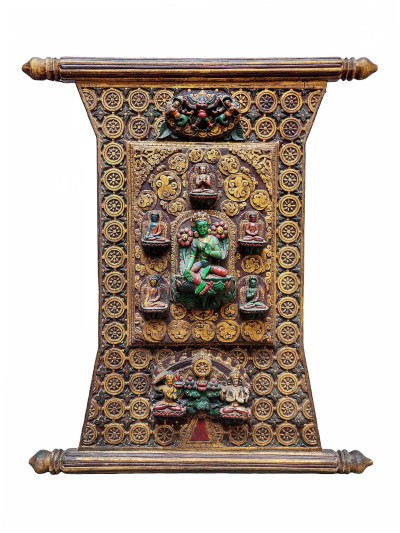
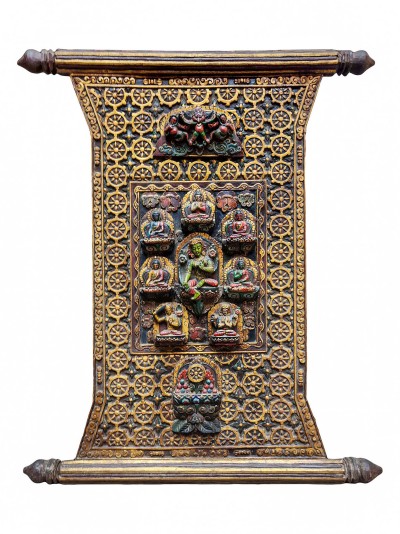
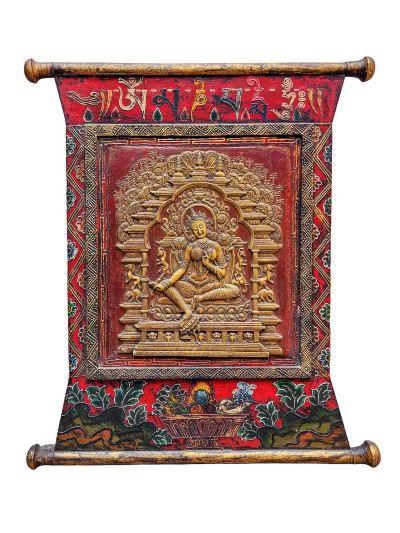
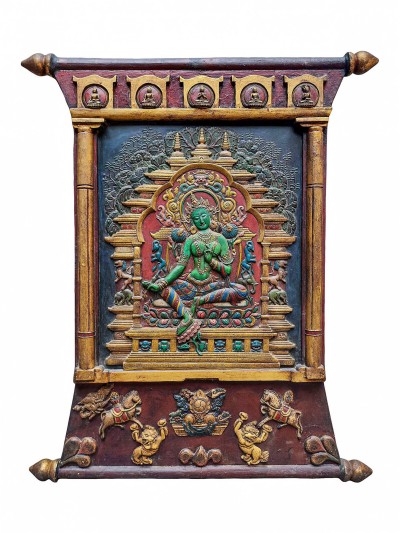
Wall hangings with Buddhist motifs are a beautiful and meaningful way to add a touch of spirituality and cultural richness to your home or office decor. These wall hangings come in a variety of materials, including wood and metal, and feature intricate designs that are inspired by Buddhist art and symbolism.
Wooden wall hangings are typically made from high-quality, sustainably sourced wood, such as teak or mahogany. These hangings are often carved with intricate designs and feature images of Buddha, bodhisattvas, or other important figures in the Buddhist tradition. They can be hung on the wall using a hook or string and add a touch of natural warmth and texture to any space.
Shipping Calculation
The shipping weight for 1 piece of the product is 1 kg, and shipping cost is USD37.00.
Note: Shipping Charge for this product will be calculated based on volumetric(dimensional) weight.
Country
Shipping Mode
We normally dispatch orders within 2 to 5 business days. If there are any delays, we will personally inform the buyer about the dispatch date.
We accept Paypal | Credit/Debit Card | Bank Transfer | Money Transfer / Remit Click Here for more Information.
We offer a simple 7-day money-back policy, with the buyer responsible for return shipping. Click Here for more Information.
Wall Hanging :
Wall hangings with Buddhist motifs are a beautiful and meaningful way to add a touch of spirituality and cultural richness to your home or office decor. These wall hangings come in a variety of materials, including wood and metal, and feature intricate designs that are inspired by Buddhist art and symbolism.
Wooden wall hangings are typically made from high-quality, sustainably sourced wood, such as teak or mahogany. These hangings are often carved with intricate designs and feature images of Buddha, bodhisattvas, or other important figures in the Buddhist tradition. They can be hung on the wall using a hook or string and add a touch of natural warmth and texture to any space.
Green Tara : Brief Introduction
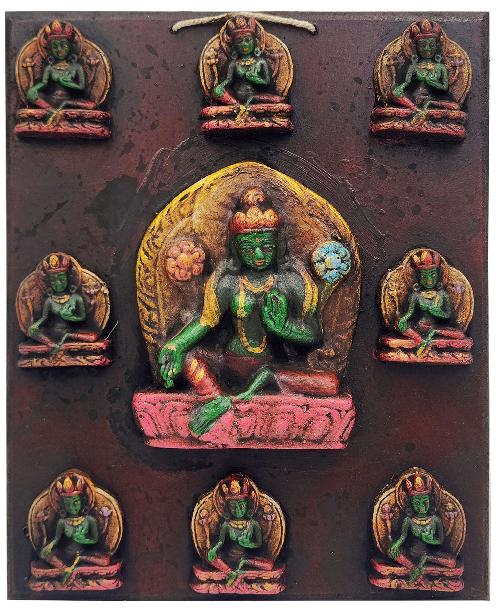
Samaya Tara, popularly known as Green Tara. She is represented in a royal ease posture with her left leg bent her left leg overstepping the main lotus and resting on a blue lotus ready to get up and offer assistance to those in need. She is portrayed with maroon Buddhist robes and jewelry. The earrings represent patience, understanding, and renunciation. The diadem with five jewels represents the transmutation of the five delusions into the Five Buddha Wisdoms. She is shown with a benevolent countenance seated upon a white moon disk which is associated with special restorative nectar associated with the naval chakra center. In Buddhists, the moon symbolizes the wisdom aspect which when coupled with compassion leads to Sakyamuni Buddha's enlightenment. Her right hand is gracefully lowered in Varada mudra, the boon-granting gesture.
Iconography Green Tara's special lotus is the blue lotus or 'night lotus' which she bears in both hands. The word utpala means to 'burst open'. Her left-hand holds a stem with an open blooming flower and an unopened bud. The bent lower part of the stem represents the root. The open blossom represents the present and also the present Buddha; the bud represents the future and also Buddhas yet to be born. The future here also refers to a safe journey's end and future well-being. Her right-hand wisdom hand is in the gesture of giving refuge. The third finger touches the thumb to create a circle representing the union of wisdom and compassion, and the three extended fingers symbolize the Three Jewels of Buddhism a. The Buddha State b. The Body of Teachings. The Principles of the Universe The same hand holds the stem of a blue lotus representing her willingness to assist. The closed blossom in her right hand represents the past and also the Buddhas of the past. Green Tara is shown in a place of paradise called Khadiravani where she Tara dwells. Khadiravani is described as a great mountain kingdom with many trees, flowers, and animals (not shown). 3 rainbow tails emanate from her outer aureole. The crescent moon and sun symbolize the union of male and female ubiquitous in Tantric art.
<br/><br/>
The seventy-two golden lines represent psychic energy channels emanating from her body and her central psychic channel running up her spinal column. Each one signifies a thousand as there are traditionally seventy-two thousand channels. The gold lines alternate between wiggly and straight to represent the two main psychic channels running up the central channel that entwine to create the interlocking 'snaking' caduceus to which the energy channels are connected. The trees in the foreground are the Ashoka Tree. The word Ashoka means 'without sorrow' and is the tree linked to the Vedic God of love and sexual union Kamadeva. Apparently, the tree blossoms when a virtuous lady touches it.
Commentary The word Tara means the one who saves. The word Tara is derived from the root tri meaning to cross and in context is taken to mean the one who helps people to cross the Ocean of Existence and Suffering. Green Tara is also called 'dark' Tara or more directly Shyama Tara. Green Tara is associated with the Amoghasiddhi who is also green and the north-facing Meditation who is head of the action family. Her willingness to help others is shown by her body posture with one foot ready so that she can rise to offer assistance. Like WhiteTara, she was born of the tears of compassion of the Bodhisattva Avalokiteshvara, resulting from the extreme state of sadness he experienced when observing the continuing ceaseless suffering which he sought to end.
Mantra for Green Tara
Om Tare Tuttare Ture Soha
Read More . . .
Amitabha Buddha : Brief Introduction
Amitabha is head of the Lotus Family, one of oldest & significant of the Five Buddha Families. This family represents love, purity, compassion & peace. Amitabha Purelandis a place of infinite bliss & boundless light. He will guide you along a path of simplicity and purity towards such a place where you can find inner contentment. Amitabha will help you overcome addictions and cravings.
Iconography Amitabha Buddha is also one of the five Tathagatas representing the wisdom of discriminating awareness (skt. Pratyavekshanajnana). When discriminating wisdom dawns on us we realize Non-production or non-origination of all things. He also represents purified form of desire.
Amitabha Buddha is red in color. He is represented in the stupa facing to the west. He rides on peacock symbolizing that he can take away the suffering of others just as the peacock eats poisonous plants and yet his tail shines forth.
Amitabha in Sanskrit means immeasurable light or limitless light. He resides in the western land of unlimited bliss (skt. Sukhavati). He is assisted by two Bodhisattvas viz. Avalokiteshvara and Mahasthamaprapta. When he was a bodhisattva he was called Bhikshu Dharmakara. He made vows to establish an adorned land of unlimited bliss to ferry over those living beings who recite his name. On the basis of those vows, any living being who has faith, makes vows and practices diligently will be received by this Buddha and reborn in the pure land of unlimited bliss.
Amitabha Buddha presides over the Bhadrakalpa i.e. Fortunate Aeon. He always exhibits Dhyana mudra. He belongs to the Lotus family. He originates from the seed syllable Hrih. He can be recognized through the symbol of the lotus. With his extensive vows and great compassion this Buddha has ferried over innumerable sentient beings. The recitation of the name of Amitabha Buddha is a common practice in China and Japan. In Tibet too, devotees recite very often the prayer to be reborn in the land of Amitabha Buddha.urity
Commentary The word 'Amitabha' is composed of 2 syllables. Amita-[Skt.] translates as infinite & -bha universal life or simply the universe. Related Sanskrit words include bha-va asin Bhavachakra & Bha-gavad as in Bhagavad Gita. Amitabha is often translated as Boundless Light which is taken to be the boundless Universe. Amitabha realised a Pure Land called Sukhavati which meanspossessinghappinessin Sanskrit. Sukhavati is situated in the uttermost west beyond the bounds of rational understanding. By the power of his vows he made it possible for all who call upon him to be reborn into this land, there to undergo instruction by him in the dharma and ultimately become bodhisattvas & Buddhas. Amitabha is one of the five Transcendent Buddhas emanated from the primeval 'Adi' Buddha Vajrdhara. Each of the transcendent Buddhas has arisen to help us overcome the five obstructions [Skt. Kleshas] to our spiritual growth and each is the Head of a Family. The Sanskrit word Klesha means poison in the sense of curruption. For this reason the transcendent Buddhas are called Wisdom Buddhas; they possess the wisdom to overcome viz. transcend the five obstructions are greed, hatred, delusion, jealousy & pride. Amitabha is formed to help us overcome greed [often expressed as desire]. Greed is conceived of as a thirst [Skt. Tanha] or appetite for the destructive things that harm us such as smoking, alcohol & selfishness. The transcendent Buddhas are sometimecalled the Meditation [Skt. Dhyana] Buddhas as people meditate on their wisdoms to overcome the five obstructions to spiritual growth to anable us to reach a higher level of understanding.
Mantra of Amitabha Buddha
Oṃ Amideva Hrīḥ
Read More . . .
Ashtamangala : Brief Introduction
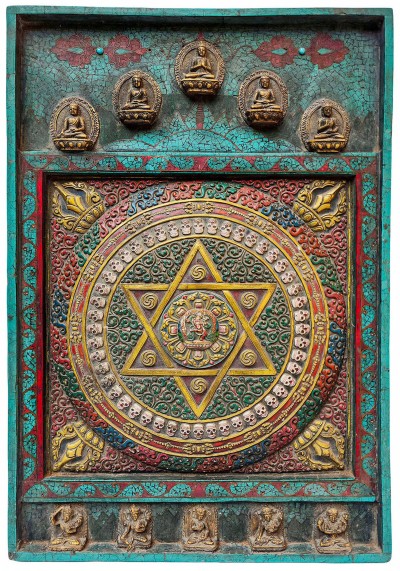
The Ashtamangala is a sacred suite of Eight Auspicious Signs endemic to a number of religions such as Hinduism, Jainism, and Buddhism. The symbols or "symbolic attributes" are yidam and teaching tools. Not only do these attributes point to qualities of enlightened mindstream, but they are the investiture that ornaments these enlightened "qualities". Many cultural enumerations and variations of the Ashtamangala are extant.
Conch The right-turning white conch shell represents the beautiful, deep, melodious, interpenetrating and pervasive sound of the dharma, which awakens disciples from the deep slumber of ignorance and urges them to accomplish their own welfare for the welfare of others
Endless knot The endless knot denotes "the auspicious mark represented by a curled noose emblematic of love" . It is a symbol of the ultimate unity of everything. Moreover, it represents the intertwining of wisdom and compassion, the mutual dependence of religious doctrine and secular affairs, the union of wisdom and method, the inseparability of śūnyatā "emptiness" and pratītyasamutpāda "interdependent origination" , and the union of wisdom and compassion in enlightenment. This knot, net or web metaphor also conveys the Buddhist teaching of interpenetration. It is also an attribute of the god Vishnu, which is said to be engraved on his chest. A similar engraving of the Shrivatsa on the historical Gautama Buddha's chest is mentioned in some lists of the Physical characteristics of the Buddha.
Pair of Golden FishThe two golden fish symbolise the auspiciousness of all sentient beings in a state of fearlessness without danger of drowning in saṃsāra. The two golden fishes are linked with the Ganges and Yamuna nadi, prana and carp:
LotusThe lotus flower , represent the primordial purity of body, speech, and mind, floating above the muddy waters of attachment and desire. The lotus symbolizes purity and renunciation. Although the lotus has its roots in the mud at the bottom of a pond, its flower lies immaculate above the water.
ParasolThe jewelled parasol , which is similar in ritual function to the baldachin or canopy: represents the protection of beings from harmful forces and illness. It represents the canopy or firmament of the sky and therefore the expansiveness and unfolding of space and the element ?ther. It represents the expansiveness, unfolding and protective quality of the sahasrara: all take refuge in the dharma under the auspiciousness of the parasol.
VaseThe treasure vase represents health, longevity, wealth, prosperity, wisdom and the phenomenon of space. The treasure vase, or pot, symbolizes the Buddha's infinite quality of teaching the dharma: no matter how many teachings he shared, the treasure never lessened.
DharmaChakraThe Dharmachakra or "Wheel of the Law" represents Gautama Buddha and the Dharma teaching. This symbol is commonly used by Tibetan Buddhists, where it sometimes also includes an inner wheel of the Gankyil. Nepalese Buddhists don't use the Wheel of Law in the eight auspicious symbols.
Vicoty BannerThe dhvaja "banner, flag" was a military standard of ancient Indian warfare. The symbol represents the Buddha's victory over the four māras, or hindrances in the path of enlightenment. These hindrances are pride, desire, disturbing emotions, and the fear of death. Within the Tibetan tradition, a list of eleven different forms of the victory banner is given to represent eleven specific methods for overcoming defilement. Many variations of the dhvaja's design can be seen on the roofs of Tibetan monasteries to symbolise the Buddha's victory over four māras. Banners are placed at the four corners of monastery and temple roofs. The cylindrical banners placed on monastery roofs are often made of beaten copper.
Read More . . .
Chakrasamvara : Brief Introduction
Chakrasamvara is a leading tantric deity who embodies great bliss [Skt. Mahasukha] realisable through a combination of wisdom and method. The idea of duality, the merging & union of two opposite forms or ideas originated thousands of years ago. Through a union of our self & the universe we become part of the Sambhogakaya realm within which great happiness which includes love, friendship, peace and joy. Chakra Sambhava is a tutelary deity seeking to guide people to great happiness.
Iconography Chakrasamvara is represented with a blue body, four faces and twelve arms in yib-yum union with his swisdom energy Vajravarahi {also known as Vajrayogini}. She holds a skullcap in her left hand behind his back and a vajra headed chopper in her right. The chakra referred to is the chakra of Supreme Bliss. Chakrasamvara is regarded as the most important meditational deity [Yidam] of Vajrayana Buddhism, & primary Yidam of the Kagyu tradition with its origin in the meditation of the eighty four Mahasiddhis of India.
He stands on a sun disc surrounded by a flaming aura of his own radiant wisdom. He wears a tiger skin loin cloth in the manner of an ascetic yogi and is adorned with both bone and jewelled ornaments and a garland of fifty freshly severed human heads. His forehead sports the third eye of wisdom and the expression on his face is a mixture of wrath and passion. Heruka embraces his red wisdom energy Vajravarahi who holds a curved knife in her right hand to cut off ego interferences and in her left behind Heruka's head she has a skull-cup symbolizing self regenerating blissful wisdom. Heruka's right leg stands on the back of the worldly deity wrathful Ishvara (also known as Bhairava), while his left leg tramples on the breast of Bhairava's consort Kalarati. this stance symbolizes the ability of Chakrasamvara to overcome the forces of ignorant hatred and desirous attachment respectively. In addition to the traditional vajra and bell, the skin of an elephant, a drum, dagger, curved knife and ant three pointed spear in his right hands, and the staff, skull-cup, noose and the head of a worldly deity in his left hands. The symbolism of these various attributes can be explained as follows (partial). The 4 faces stand for the 4 doors of liberation.
His twelve arms signify the purification of the twelve links of dependent arising explained in the Wheel of Life The vajra and bell symbolize the supreme unification of method and wisdom. The elephant skin illustrates the abandonment of ignorance. The hand drum enhances the blissful happiness experienced in the minds of all fully enlightened ones. The dagger and curved knife cut off the thre poisons as the hub of the Wheel of Becoming [Skt. Bhavachakra] and eliminate all extreme views, while the 3-pointed spear pierces through the delusions of the 3 realms of existence. The green orb around Chakrasaṃvara's head symbolizes the enlightened transformation of sensual desire through the union of bliss and emptiness.
Commentary Chakrasamvara is sometimes called Heruka. The term Heruka is also be applied to all wrathful male deities of high-end tantra yoga. In Sanskrit Chakrasamvara means 'Born or arising from the Chakra'. The chakra refers to the wheel of life. Sometimes the deity is called 'Chakrasamvara' means "Binding the Chakra or controlling the Chakras. Chakrasamvara is a heruka which means a divine father energy & the two armed form of Chakrasamvara is often called Heruka. Hi is a principal meditational deity [Skt. Istha-devata especially of the Kagyu. The Chakrasamvara sadhana is in the mother class of the Anuttara Yoga Tantra. Their embrace symbolizes the union of wisdom and skillful means. They symbolize the sameness in the distinctions of relative truth and the non-distinctions of absolute truth. Chakrasaṃvara, the Wrathful Lord of the Wheel of Supreme Bliss, is one of the major meditational deities of the mother tantras.
Mantra of Chakrasamvara
OM SHRI VAJRA HE HE RU RU KAM HUM HUM P'HAT DAKINI DZALA SHAMBARAM SVAHA
Read More . . .
Metal wall hangings are also popular and come in a variety of styles and finishes, such as brass, bronze, or copper. These hangings are often crafted with a high level of detail and feature intricate designs that are inspired by Buddhist art and symbolism. They can be hung on the wall using a hook or bracket and add a touch of elegance and shine to any space.
Buddhist wall hangings often feature symbols and motifs that have deep spiritual significance in the Buddhist tradition, such as the lotus flower, the eight auspicious symbols, or the endless knot. These symbols are believed to bring positive energy and peace to the space they occupy, making them a popular choice for meditation rooms or other sacred spaces.
Overall, wall hangings with Buddhist motifs are a beautiful and meaningful way to add a touch of spirituality and cultural richness to your home or office decor. They make a great gift for anyone who values art, spirituality, and cultural diversity.
You may also want to read the related articles :
At Handicraft Seller, we believe in providing a seamless and user-friendly experience to our valued customers. While our website is not an online shopping platform, we have incorporated a shopping cart system to simplify the process of sending us your inquiries. Please follow the steps below to place your order:
Step 1: Browsing the Selection Explore our website to discover a delightful array of authentic Nepali handicraft products. Click on the products you are interested in to view detailed descriptions and images.
Step 2: Adding Items to Your Inquiry Cart To express your interest in a particular product, click the "Add to Inquiry Cart" button associated with that item. The shopping cart will accumulate your selected products, providing a convenient way to organize your choices.
Step 3: Reviewing Your Inquiry Cart Once you have finished selecting the items you wish to inquire about, review your "Inquiry Cart" to ensure accuracy.
Step 4: Sending Your Inquiries Proceed to submit your inquiries by clicking the "Submit Inquiry" button. A form will prompt you to provide your contact details, the selected products, and any specific queries you may have.
Step 5: Communicating through Email As we do not have an automated payment system, we will conduct the business process through email. Our team will review your inquiries and respond via email, offering further assistance and guidance.
Step 6: Clarifying Details and Finalizing Your Order Engage in direct communication with our team to clarify any additional information or customization requests. Once you are satisfied with the details, we will provide you with payment instructions and confirm the order.
Step 7: Completing the Transaction Make the payment through the designated method as provided in the email. After receiving the payment, we will process your order and prepare it for shipment.
Step 8: Shipping and Delivery We offer worldwide shipping for all our products. Once your order is dispatched, we will provide you with shipping details and tracking information.
Step 9: Receiving and Enjoying Your Handicrafts Wait for your exquisite handicrafts to arrive at your doorstep. Unpack and revel in the beauty and craftsmanship of your chosen Nepali treasures.
Contacting Us If you encounter any complications while submitting your inquiries or need further assistance, please feel free to contact us. Preferably, reach out to us through WhatsApp or email for prompt responses and support.
We hope this straightforward ordering process ensures a delightful and satisfying experience with Handicraft Seller. Thank you for choosing us to connect you with the rich heritage of Nepali handicrafts.
Return Policy
We have a 7 days money back policy but buyer have to pay the return shipping charges.
Shipping
Shipping cost is calculated, based on the shipping weight of the products ordered. THe normal Shipping cost is US$25 for upto 0.5 kgs weight
We ship Worldwide, Except Russia and India.
The deliver duration varies for international Shipping location. We normally dispatch the product in 2 -3 business days. Else Buyer will be infromed Personally about the shipping.
This is not a direct shopping website. So no payments are needed for placing an order. Please feel free to send us an order for the product you are interested in, mentioning the approximate quantity. Based on which we will send you a wholesale price quotation.
![Wooden Wall Hangings Of Chakrasambara With Ashthamangala And Amitabha Buddha And Green Tara [resing Statue]](https://www.handmadeexpo.com/pics/product/29893.jpg)

![Wooden Wall Hangings Of Chakrasambara With Ashthamangala And Amitabha Buddha And Green Tara [resing Statue]](https://www.handmadeexpo.com/pics/product/thumb/29893.jpg)
![Wooden Wall Hangings Of Chakrasambara With Ashthamangala And Amitabha Buddha And Green Tara [resing Statue]](https://www.handmadeexpo.com/pics/product/thumb/29893_0.jpg)